Data clean rooms promised brands a key to retailer data. Here is the room and what is not in it.
In January 2026, AdExchanger published a piece titled "Why 2025 Marked the End of the Data Clean Room Era." Not because clean rooms stopped working — but because the term had done its job, been absorbed into standard data infrastructure, and revealed its limits in the process. Clean rooms are a genuine measurement improvement. They are not the complete measurement solution they were positioned as.

In January 2026, AdExchanger published a piece titled "Why 2025 Marked the End of the Data Clean Room Era." Not because clean rooms stopped working — but because the term had done its job, been absorbed into standard data infrastructure, and revealed its limits in the process. Clean rooms are a genuine measurement improvement. They are not the complete measurement solution they were positioned as. Understanding the difference determines whether a brand builds the right measurement infrastructure or discovers two years from now that the room it invested in has walls on three sides and an open field on the fourth.
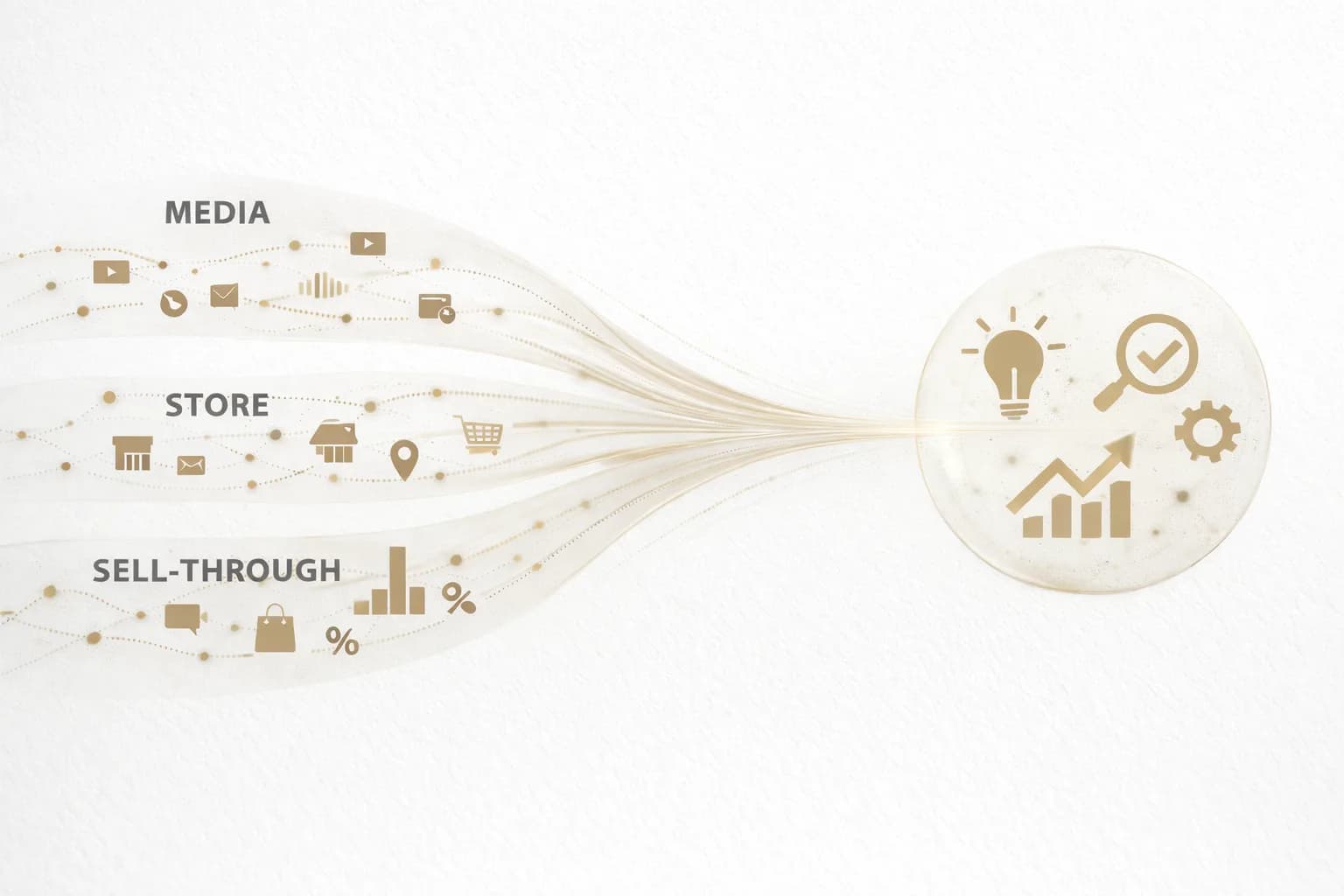
A data clean room connects brand data to one retailer's first-party data. The brand's commercial footprint extends well beyond the walls of any single clean room.
What clean rooms actually are and what drove their rise
A data clean room is a secure, privacy-compliant environment where two or more parties — typically a brand and a retailer, or a brand and a media platform — can combine their first-party datasets without either party exposing raw records to the other. Aggregated insights emerge from the collaboration. Neither party can extract the underlying data or identify individual consumers.
The architecture is genuinely useful. It solves a specific problem that became structurally urgent as third-party cookie deprecation, GDPR, and US state-level privacy laws progressively constrained the user-level data that standard digital attribution relied on. Brands needed a way to access retailer purchase data to close the loop between ad exposure and commercial outcome. Retailers needed to offer that capability without surrendering data that is central to their own competitive advantage. Clean rooms make that exchange possible.
The market responded at speed. The data clean room market reached approximately $3.2 billion in 2025 and is projected to reach $18.6 billion by 2034 at a 21.7% annual growth rate. In Forrester's Q4 2024 CMO Pulse Survey, 90% of B2C marketers said they use a data clean room for marketing purposes. Amazon expanded its Marketing Cloud (AMC) significantly in September 2025, making it free for all Sponsored Ads advertisers and removing cost barriers that had previously limited clean room access to larger brands with dedicated data teams.
The infrastructure is real. The adoption is real. And the limits, which become visible when you understand what is actually inside the room and what is not, are equally real.
The promise and its underlying logic
The promise that drove clean room investment was compelling precisely because it addressed the most frustrating structural problem in FMCG measurement: brands cannot see their own commercial outcomes at retail. Retailers own the purchase data. Brands own the campaign data. The connection between them — the proof that campaign investment produced sell-through — requires both datasets in the same analysis.
Clean rooms offered that connection without requiring either party to surrender their data. A brand could upload its campaign exposure data — hashed, anonymized, privacy-safe — and the retailer's purchase data could be matched against it within the secure environment. The output: aggregated insight into how many consumers who were exposed to the brand's campaign subsequently purchased the product at that retailer.
For brands that had previously been completely blind to the relationship between their campaign investment and retailer sell-through, this was a genuine leap forward. CVS Media Exchange partnered with Pinterest on a clean room that cross-referenced ExtraCare member purchasing data with Pinterest exposure data, enabling closed-loop reporting for suppliers. Carrefour has used clean rooms with suppliers to connect campaign data to in-store sales. The use cases are real and the insights they produce are valuable.
The question is not whether clean rooms work. They do. The question is what problem they solve — and what they leave unsolved.
The room and what is not in it
The room contains one retailer's data. This is the structural boundary that defines everything else about clean room measurement. Amazon's clean room contains Amazon's data. Walmart's clean room contains Walmart's data. Kroger's clean room contains Kroger's. The brand that runs all three is running three separate analyses, each producing insights about what happened inside one retailer's ecosystem.
The brand cannot combine those analyses into a single picture of what its campaign produced across its full retail distribution. As Flywheel's analysis of clean room architecture puts it explicitly: "Retailers will never allow brands to completely extract their data to be inputted elsewhere for comparison against other retailers." The insights that Amazon's clean room produces stay inside Amazon's clean room. The same is true at Walmart, at Kroger, at Target. The portfolio-level question — what did this campaign produce across my entire retail footprint — is not answerable from any combination of single-retailer clean rooms, because the data sharing agreements that make each clean room possible also prevent the cross-retailer aggregation the portfolio question requires.
For a brand selling through Amazon, Walmart, Target, Costco, and a national drugstore chain simultaneously — a standard distribution profile for a mid-to-large FMCG or beauty brand — five separate clean room analyses produce five separate measurements of what happened inside five separate retailer ecosystems. The brand's campaign portfolio ran across all five simultaneously. The causal contribution of that portfolio to each retail outcome remains as unmeasured as it was before the clean rooms were built.
The room does not contain traditional trade. Clean rooms exist where retailers have sophisticated enough first-party data infrastructure to build and operate them. Amazon, Walmart, Target, Tesco, and Carrefour have that infrastructure. Independent pharmacies, warungs, small-format distributors, and the traditional trade channels that represent a substantial share of FMCG volume in markets like Indonesia, Germany's non-modern trade, and most of Southeast Asia do not. For brands whose distribution reaches beyond modern trade — which in many FMCG categories means the majority of their volume — clean rooms cover the data-rich minority of their commercial footprint and leave the data-sparse majority unconnected.
The room produces attribution, not incrementality. A clean room insight that shows consumers exposed to a brand's campaign purchasing at a retailer is a correlation measurement: these consumers saw the ad and subsequently bought the product. It is better attribution than last-click because it uses first-party purchase data rather than platform-reported conversion events. But it is still attribution. It cannot answer whether those consumers would have purchased anyway, whether the campaign caused the purchase or was simply present in the journey of someone who had already decided, or how much of the purchase lift was genuinely driven by the campaign versus the retailer's own promotional activity running in the same period. Incrementality — the causal contribution of campaign investment to commercial outcome — requires experimental design or causal inference methods that most clean room implementations do not include.
The room requires capabilities many brands do not have. Skai's 2025 State of Data Clean Rooms in Retail Media research found that 41% of respondents cite integrating clean rooms into existing optimization and analysis practices as their top hurdle, up from the prior year. 34% cite lack of internal expertise — clean rooms require SQL proficiency and data science capabilities that many brand marketing teams do not have in-house. 48% of marketers and agencies cite lack of budget as the reason they are not planning to use clean rooms at all, according to Cint and Lotame research from July 2024. And as of Q2 2025, fewer than half — 48% of US retail media networks — even offer clean room capabilities, according to Mars United Commerce.
The gap between what clean rooms could theoretically produce and what the average brand can actually extract from them is substantial. The infrastructure requires real technical lift, real organizational coordination, and real data science capability to generate actionable outputs rather than aggregated statistics that sit in a dashboard and inform no decision.
Where clean rooms end and behavioral intelligence begins
The natural question after mapping these limits is: what sits above clean rooms in the measurement stack, and what does it add that the rooms cannot provide?
Behavioral intelligence is not a replacement for clean rooms. It is the analytical layer that operates where clean rooms either cannot reach or cannot produce causal answers.
Clean rooms are partnership infrastructure. They require bilateral data sharing agreements between a brand and a specific retailer, technical integration between two data systems, and ongoing governance of the shared environment. This is expensive and time-consuming to establish with one major retailer. Establishing it with every retailer in a brand's distribution, including those without clean room capability, is not feasible for most brand marketing teams.
Geographic causal inference — the approach at the core of Veinera's behavioral intelligence architecture — does not require data sharing agreements or access to individual-level purchase records. It requires sell-through data at the regional and retailer level (which brands receive through standard commercial relationships), campaign exposure patterns at geographic resolution (which brands generate through their own media buying), and causal methods that connect the two.
This approach can reach traditional trade channels where clean rooms cannot. It can produce portfolio-level causal estimates across multiple retailers simultaneously by working with the geographic variation in campaign exposure as the analytical lever, rather than requiring matched identity records between campaign and purchase. And it produces incrementality rather than attribution — the causal estimate of what the campaign actually caused, rather than a correlation between campaign presence and purchase outcome.
The Flywheel analysis of clean room architecture concludes with a direction that maps exactly to this: "There's no doubt that this is where the industry is heading, shifting toward behavioral insights and purchase data as the guiding forces for media strategies which can be fully measured in a deterministic manner." Clean rooms produce better correlation data within their walls. Behavioral intelligence produces causal answers across the full commercial footprint.
What this means for how brands should sequence their measurement investment
The sequencing matters more than the technology choice. Clean rooms and behavioral intelligence serve different measurement needs, and understanding the sequence prevents the most common mistake: investing in clean room infrastructure as a substitute for portfolio-level causal measurement, then discovering that the clean rooms cannot answer the questions that brand leadership actually needs answered.
The right frame is complementary layers, not competing alternatives.
Clean rooms answer the within-retailer question: within the Amazon or Walmart ecosystem, what did my campaign produce for this specific retailer's customer base? This is valuable for optimizing retail media investment within specific networks, for understanding audience overlap and segment performance within a retailer's data environment, and for building the attribution foundation that demonstrates ROI to that retailer.
Behavioral intelligence answers the portfolio question: across my full commercial footprint — every retailer, every channel, every market — what did my campaign actually cause, and how do I allocate my next investment to maximize sell-through across the complete distribution network?
Both questions matter. The mistake is treating clean rooms as sufficient for the second question when they were only ever designed to answer the first. The brands that understand this distinction and build measurement architecture accordingly will have a clearer picture of their campaign contribution than those that stop at the clean room wall.
The end of the clean room era is not the end of the problem
AdExchanger's January 2026 assessment that 2025 marked the end of the data clean room era was not a verdict on clean room technology. It was an observation that the category had matured from a specific technology requiring explicit understanding to a piece of infrastructure that has been absorbed into standard data collaboration practice. The term lost salience. The underlying function remains.
What the maturation revealed is that clean rooms, like retail media's closed loop before them, are better measurement than what preceded them and insufficient for the full measurement problem they were positioned to solve. The FMCG and beauty brands that have built clean room infrastructure have better insight into what happens inside specific retailer ecosystems. They still do not have causal measurement across their full commercial footprint.
That is the remaining problem. And it is the one behavioral intelligence is built to address.
Sources and references
- AdExchanger. Why 2025 Marked the End of the Data Clean Room Era. Adam Solomon, LiveRamp VP: "No brand marketer or agency buyer starts with the idea that they want a clean room." January 2026.
- Market Intel Group. Data Clean Room Market Research Report 2034. Market size: $3.2 billion in 2025, projected $18.6 billion by 2034, CAGR 21.7%.
- Forrester. Deciphering the Data Clean Room Landscape, Q4 2024. 90% of B2C marketers say they use a data clean room for marketing purposes. January 2025.
- Skai. The 2025 State of Data Clean Rooms in Retail Media. 66% of organizations using clean rooms; 41% cite integration as top hurdle; 34% cite lack of internal expertise. December 2025.
- EMARKETER. FAQ on Data Clean Rooms. 48% of marketers and agencies cite lack of budget as reason not to use clean rooms (Cint and Lotame, July 2024); 48% of US retail media networks offer clean room capabilities (Mars United Commerce, Q2 2025). January 2026.
- Flywheel Digital. Clean Rooms and AMC: What Every Advertiser Should Know. "Retailers will never allow brands to completely extract their data to be inputted elsewhere for comparison against other retailers." April 2025.
- DinMo. Data Clean Rooms. Carrefour using DCRs with suppliers to boost in-store sales from campaigns. December 2025.
- Amazon. AMC expanded free access for all Sponsored Ads advertisers, September 2025.
- Skai / IAB. Clean rooms becoming "connective tissue between purchase data, campaign measurement, and privacy compliance." 2025 State of Retail Media report.
Veinera operates above the clean room layer — connecting campaign signals to sell-through outcomes across the full retail footprint using causal inference methods that do not require bilateral data sharing agreements. Book a 30-minute walkthrough, no commitment.
Related reading
- Retail media promised closed-loop measurement. Here is what it actually delivered. · May 31, 2026
- The AI feature problem — why bolting intelligence onto reporting does not produce intelligence · May 10, 2026
- The offline data desert — why the most valuable behavioral signal is the hardest to reach · Apr 19, 2026