The four layers of campaign performance
Campaign outcomes are shaped by four interacting layers: content, distribution, conversion, and execution. Here is how Veinera examines each — and why isolating them produces confident misdirection.
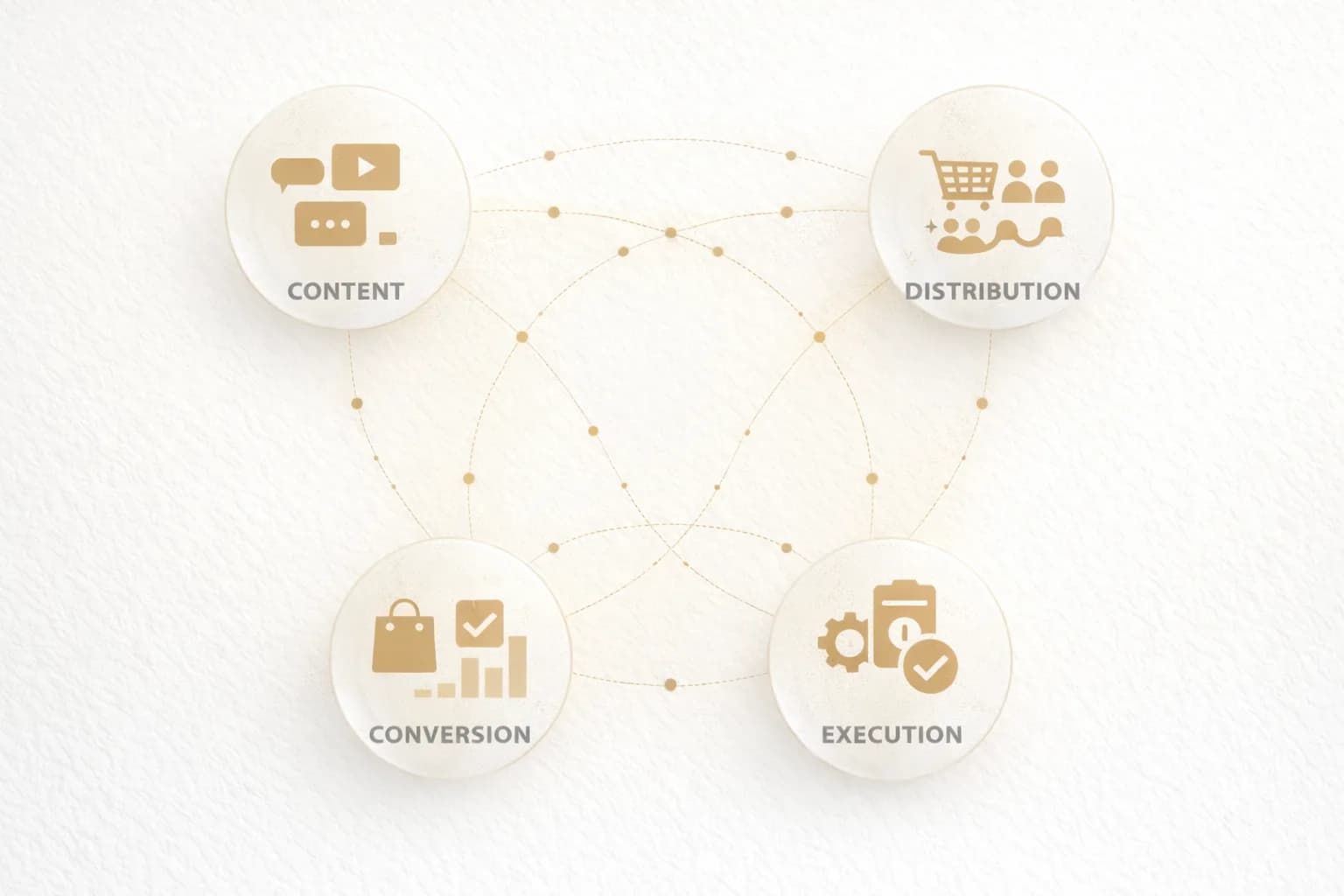
Campaign outcomes are shaped by four interacting layers: content, distribution, conversion, and execution. Here is how Veinera examines each — and why isolating them produces confident misdirection.
When a campaign underperforms, the first instinct is usually to blame one variable — the creative, the targeting, the landing page, the moment it shipped. Most of the time, that instinct is wrong.
Campaign outcomes are rarely shaped by a single lever. They emerge from the interaction of four layers, each capable of distorting the signal in the others. Understanding each layer individually matters. Understanding how they compound is what produces an accurate diagnosis.
Veinera examines all four.
Layer 1 — Content response
Content response is the audience's reaction to the creative itself: whether attention is captured, whether it is sustained, and whether the engagement produced reflects genuine resonance or surface-level contact.
This is where campaigns are most often diagnosed too quickly. A high view count says something. A high view-through rate says more. But neither tells you whether the attention was earned by the message or by the format, whether resonance is concentrated in a specific segment or spread across audiences that will never convert, or whether engagement was decaying from the first second or holding across the full creative duration.
The distinction between sustained and decaying attention has a direct commercial consequence. Research presented at Cannes Lions and reported by WARC shows that fast-decay formats — those where active viewing begins high and drops rapidly — can move from 61% active viewing at the open to roughly 1% by the end. Slow-decay formats perform differently, holding attention longer but often burning less brightly at the start. Neither profile is universally better. But conflating them in aggregate reporting produces an average that describes neither accurately.
Kantar's tracking data makes the stakes clear: across ads evaluated in their database over the past three years, the Attention Percentile has declined by 31%. Meanwhile, Kantar's Media Reactions 2024 found that only 31% of people globally say that social media ads capture their attention — a figure that has declined year-over-year. In an environment of compressing attention, whether a creative earns and sustains engagement is not a qualitative judgment. It is the determinant of whether the rest of the investment has any foundation at all.
What the interpretation layer adds: not whether view-through rate moved, but how and where attention moved — and what that pattern implies about the audience receiving the message.
Layer 2 — Distribution quality
A strong creative delivered to the wrong audience is worse than a mediocre creative delivered to the right one. This is not a platitude. It is a diagnostic problem with a specific signature.
When paid campaigns convert at a materially lower rate than organic traffic, the instinct is often to blame the creative or the offer. Analysis from funnel practitioners and conversion researchers consistently points elsewhere: the more common cause is audience misalignment — the campaign is reaching people who were never likely to convert, inflating reach metrics while diluting the signal available for optimization.
Distribution quality examines three things that aggregate channel metrics obscure:
Channel fit. Whether the placement context is consistent with the message. A content piece designed for sustained attention performs differently on a high-attention platform than on a low-attention one, regardless of its intrinsic quality. WARC's attention research shows that a high-emotion ad will draw 18% more viewing seconds on a high-attention platform — but only 3% more on a low-attention one. The platform context shapes the effective output of the creative, independently of what the creative does.
Audience overlap. Whether the distribution is reaching new demand or retreading segments already exposed. Audience saturation is one of the most persistent sources of diminishing returns in paid campaign performance, and one of the least visible in standard reporting.
Timing alignment. Whether delivery is concentrated in windows when the audience is actually receptive. Timing is particularly consequential in omnichannel campaigns, where the gap between online campaign exposure and the moments of offline purchase decision may span days or weeks — and where the sequence of touchpoints matters as much as the touchpoints themselves.
Distribution is the layer most frequently over-optimized in isolation. A campaign team that narrows audience targeting or adjusts bid strategies in response to a conversion-rate drop may be solving the right problem. It may also be adding constraint to a distribution system that was performing correctly — while the actual cause lives in the creative or execution layer.
Layer 3 — Conversion behavior
Conversion is the movement from attention and intent to action. The gap between the two is where campaigns quietly lose revenue that was already within reach.
Cart and purchase abandonment data illustrates how large this gap typically is. Research from the Baymard Institute, examining behavior across major e-commerce environments, puts average cart abandonment at approximately 70% — meaning the majority of people who reach the decision step do not complete it. This is not primarily a campaign problem. But it interacts directly with campaign performance: a campaign that delivers strong intent to a frictionful conversion environment will systematically underperform its potential, producing outcomes that get attributed to content or targeting when the actual failure is further down.
The friction that matters in conversion behavior is not always visible in standard funnel metrics. A drop in conversion rate at a specific step is visible. Whether that drop is caused by form field volume, unclear pricing, misalignment between the campaign promise and the product page, or a trust signal that is absent at the moment of decision — that requires a different kind of examination.
The most important diagnostic question in this layer is not where conversion drops. It is whether the environment the audience arrives in is consistent with the promise the campaign made. When the creative builds one expectation and the conversion environment delivers another, hesitation is the natural response — and hesitation, once established, rarely resolves into purchase without additional intervention.
Conversion behavior is also the layer most likely to be misattributed. Poor conversion rates look like an audience problem until you examine whether the traffic being driven was actually aligned with the offer. They look like a creative problem until you check whether the drop-off is happening before or after the first meaningful engagement with the page. Diagnosis requires isolating the layer — and then checking whether the diagnosis holds when the other layers are considered.
Layer 4 — Execution flow
Execution flow is the operational condition of the campaign itself — and it is the layer most consistently overlooked in post-campaign analysis.
Execution encompasses the coordination across teams and handoffs, timing consistency across channels, and the implementation quality gap between what was planned and what was actually deployed. It is not a strategic concept. It is an operational one. And operational failures in campaigns are more common, and more consequential, than performance conversations typically acknowledge.
Harvard Business Review's research finds that 67% of well-formulated strategies fail due to poor execution — not because the strategy was wrong, but because the gap between planning and deployment erodes what the strategy was designed to accomplish. The same dynamic applies at campaign level. A media plan that requires coordination across creative, paid, retail, and field teams across multiple markets contains many points where timing can slip, messaging can drift, or deployment can diverge from plan.
The specific pattern in consumer-brand campaigns — where online media runs in parallel with offline distribution, retail placement, and field execution — makes execution failures particularly hard to diagnose. As one analysis of brand retail execution describes it: marketing teams build the plan, operations teams deploy it, and field teams execute it. These groups often operate in different systems on different timelines. Miscommunication about timing, priorities, or standards causes well-designed programs to break down before they reach the consumer — while the reporting layer records the outcome as a campaign performance problem, not an operational one.
Execution gaps rarely appear as a named metric. They appear as unexplained variance: performance that is weaker than the creative, distribution, and conversion layers would predict, with no obvious single cause. That is the signature. Recognizing it requires a system designed to look for it.
The cross-layer dynamic
Here is the part most analytics stacks miss — and the most important thing to understand about why layer-by-layer diagnosis produces the wrong answer.
Performance is almost never determined by a single layer. It is shaped by the compounding interaction of several. A content signal that would have converted cleanly in better conditions can collapse if distribution placed it in front of the wrong audience, or if an execution gap delayed follow-through past the window of intent. A well-targeted distribution strategy can be wasted by a conversion environment that breaks trust at the moment of decision. A strong creative and precise targeting combination can fail entirely if execution timing drifts and the media investment does not coincide with the period when the product is available in the channel.
Funnel charts — the most common tool for visualizing campaign performance — are, by design, layer-agnostic. They show where momentum stalled. They do not show whether the stall was caused by the layer they measure or by a compounding effect from a layer upstream or downstream. As conversion researchers have noted, funnel charts are static snapshots: they reveal drop-off locations, but not causal patterns, trend dynamics, or segment-level behavior.
Gartner's research on campaign management, drawn from a survey of 418 senior marketing decision-makers in 2024, identifies the same structural problem from the operational side: campaign issues multiply because of the volume of campaigns and the channel fragmentation and data silos that exist as a natural byproduct of the digital environment. Combining these into coherent, cross-layer stories is described as a persistent challenge even for sophisticated marketing organizations.
Examining layers in isolation tells you where a metric moved. Examining them as an interconnected system tells you why — and, more usefully, which lever is actually worth pulling.
What this means for how Veinera examines campaigns
Veinera's diagnostic approach is built around the cross-layer view, not the single-layer view.
The four layers are input to a unified examination, not sequential steps in a checklist. The goal is not to score each layer independently but to understand how signals across content response, distribution quality, conversion behavior, and execution flow interact to produce the outcome that landed — and where in that interaction the campaign's performance potential was lost.
In practice, this means the interpretation layer looks for cross-layer signatures, not just individual anomalies. A content signal that decays faster than expected alongside a distribution pattern that under-indexes on the right segments and a conversion environment with a specific friction pattern — examined together, that picture produces a different and more accurate diagnosis than any one of those observations in isolation.
The campaign becomes legible as a system. And systems can be changed precisely, rather than optimized noisily.
Sources and references
- WARC / Cannes Lions. Research on active attention decay by format — fast-decay vs slow-decay profiles; high-emotion ad performance on high-attention vs low-attention platforms. Reported from Australian dataset presented at Cannes Lions.
- Kantar. Media Reactions 2024. Global data on social media ad attention (31% global claim ads capture attention). Kantar LINK database: Attention Percentile declined 31% across evaluated ads over three years.
- Baymard Institute. Research on average e-commerce cart abandonment. Reported across multiple conversion optimization studies.
- Count.co. Analysis of funnel conversion by traffic source (organic search vs paid social conversion rate divergence as audience misalignment signal), 2025.
- Funnel.io. Using Funnel Analysis to Grow Your Business. Including characterization of funnel charts as static snapshots, October 2025.
- Harvard Business Review. Finding that 67% of well-formulated strategies fail due to poor execution. Via The Strategy Institute, December 2025.
- Third Channel. How Brands Close the Expectation-Execution Gap. Analysis of sell-in vs sell-through measurement gap; operational execution failure patterns in consumer brand retail campaigns, October 2025.
- Gartner. 2024 Channel Campaign Management Survey. Survey of 418 senior marketing decision-makers (194 North America, 224 Europe), July to September 2024. Via Marketing Dive, December 2024.