When AI agents do the shopping — what behavioral intelligence looks like when the consumer is no longer browsing
Amazon's Rufus has 300 million users. ChatGPT Instant Checkout went live in September 2025. McKinsey projects AI agents will influence $3 to $5 trillion in global retail spend by 2030. When an AI agent is in the loop, the behavioral chain your campaign was built to influence looks structurally different — and the measurement infrastructure built for human browsing cannot see it.
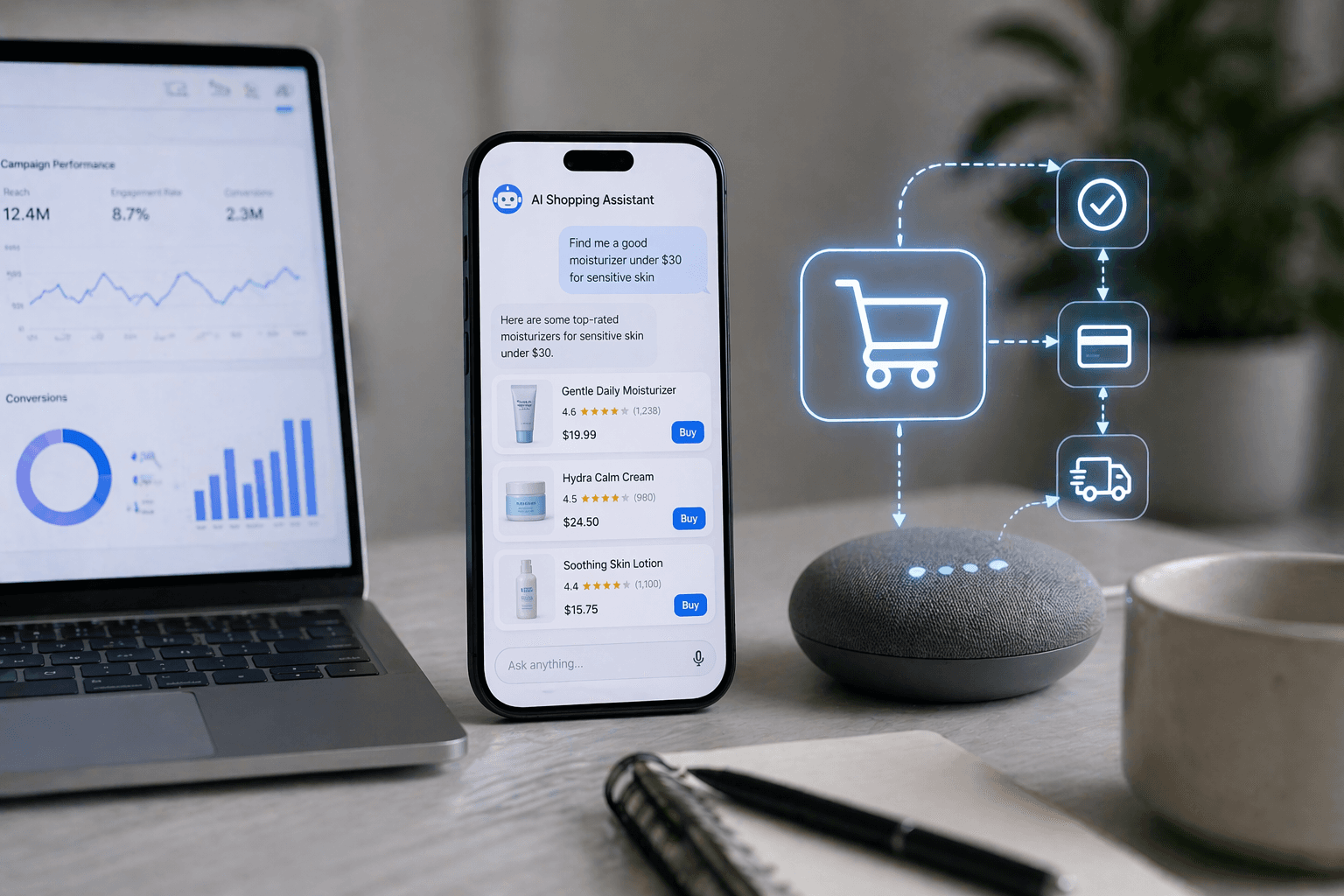
Amazon's Rufus has 300 million users. ChatGPT Instant Checkout went live in September 2025. Google's Universal Commerce Protocol launched in January 2026 with Walmart, Target, and 20+ retail partners. McKinsey projects AI agents will influence $3 to $5 trillion in global retail spend by 2030. The consumer who sees a campaign, develops intent, browses a product page, and makes a decision is still the majority of commerce. But the intermediary sitting between that consumer and the purchase decision is changing. When an AI agent is in the loop, the behavioral chain your campaign was built to influence looks structurally different — and the measurement infrastructure built for human browsing cannot see it.
The behavioral chain between campaign and sell-through now has a new intermediary. AI agents process signals differently from human consumers — and the measurement infrastructure for the human chain cannot see what happens in the agent layer.
What is actually happening right now
This is not a prediction piece. The infrastructure exists, is live, and is being used at scale today.
Amazon's Rufus AI shopping assistant — embedded inside the world's largest e-commerce platform — now serves 300 million users, drives 60% higher conversion rates among active users, and generated an estimated $12 billion in incremental sales in 2025, according to data compiled by Opascope. Its newest capability, "Buy For Me," allows consumers to purchase products from other brands' websites without leaving Amazon's app. Amazon sessions that included Rufus on Black Friday 2025 resulted in a 75% day-over-day surge in completed purchases, compared to 35% for sessions without Rufus involvement, according to Sensor Tower analysis.
ChatGPT's Instant Checkout — built with Stripe's Agentic Commerce Protocol — went live in September 2025 and now reaches 900 million weekly ChatGPT users, with retailer partners including Target, Instacart, and DoorDash. Google launched its Universal Commerce Protocol in January 2026 with Walmart, Target, Shopify, Etsy, and more than 20 additional retail partners, enabling autonomous agentic purchasing within Google AI Mode.
Perplexity's shopping agent launched for US subscribers in late 2024 and has since added autonomous checkout via PayPal integration. Visa and Mastercard have both introduced agent payment frameworks — infrastructure designed specifically for AI agents initiating transactions on behalf of users.
Adobe reported that AI-driven traffic to US retail sites jumped 670% year-over-year on Cyber Monday 2025. Salesforce's State of Commerce report found that 73% of consumers reported using AI agents or AI-powered assistants at some point in their purchase journey in 2026. McKinsey's projection: agentic commerce could redirect $3 to $5 trillion in global retail spend by 2030, with approximately $1 trillion from the US market alone.
The agent is in the consumer's purchase journey. The question is what that means for brands whose campaigns were built to influence a different kind of consumer decision process.
How AI agents make product decisions — and why it is structurally different
The most important thing to understand about agentic commerce is not that AI agents exist. It is how they evaluate products, and what signals they weight in their recommendations.
Human consumers make purchase decisions through a process that current behavioral intelligence frameworks understand well: attention is captured by creative content, resonance is built through emotional engagement and social proof, intent crystallizes through repeated exposure and consideration, and conversion happens at a moment of purchase where friction is the key variable. Campaign measurement built for this process — content resonance signals, attention metrics, conversion tracking, creator engagement rates — captures the behavioral dynamics that determine whether a human consumer makes a purchase decision.
AI shopping agents operate on a structurally different evaluation framework. They do not get the emotional resonance of a creator video. They parse structured data.
When a consumer asks an AI agent "find me a good SPF 50 moisturizer under $30," the agent does not recall which brand had the most compelling TikTok presence last month. It queries available product data across supported merchants, evaluates reviews for patterns — recurring complaints, documented edge cases, sentiment stability over time — assesses price relative to category, checks inventory availability and delivery timing, and weights these inputs against the user's stated preferences and purchase history.
Google's Shopping Graph — the infrastructure behind Google's agentic shopping experience — contains 50 billion product listings and refreshes with 2 billion updates per hour, according to Previsible.io's analysis. The system uses inventory availability as a reasoning input: brands whose stock data is slow, inconsistent, or missing location granularity quietly drop out of the agent's decision path entirely, regardless of how much campaign investment went into creating awareness of that product.
Amazon's Rufus converts millions of unstructured consumer reviews into structured insights — "runs small," "battery lasts 8 hours," "good for winter travel" — and weights those structured insights heavily in product recommendations. The quality and recency of a brand's review ecosystem now functions as a product data asset that determines agent recommendation probability.
The behavioral chain is different. The signals that influence agent decisions are different. And the measurement infrastructure built for human browsing sees almost none of it.
The measurement blind spot this creates
Standard campaign measurement assumes a purchase decision made by a human who was present at a campaign moment. The attribution models, the conversion windows, the creative performance metrics — all of these are calibrated to the behavioral dynamics of a human browsing and buying.
When an AI agent mediates the purchase decision, several things break simultaneously.
No click data from agent-mediated purchases. When a consumer authorizes ChatGPT to complete a purchase on their behalf, or when Amazon Rufus executes a "Buy For Me" transaction, there is no product page visit, no add-to-cart event, no standard checkout sequence for the brand's analytics to capture. The conversion happens inside the agent's infrastructure, in a channel the brand's measurement stack was never designed to see. eMarketer projects AI platforms will account for $20.9 billion in e-commerce sales in 2026 — nearly quadruple 2025 figures. That is $20.9 billion worth of transactions happening in a channel with effectively no click attribution available to brands.
Campaign signals and agent signals are not the same signals. A brand that runs a TikTok creator campaign and sees strong engagement metrics — high view-through rate, positive comment sentiment, creator audience resonance — has optimized for the signals that influence human purchase intent. Those signals do not directly feed into agent recommendation algorithms. The agent evaluating the same product in response to a consumer query is reading review patterns, structured product descriptions, pricing competitiveness, and inventory reliability. The campaign that primed the human consumer's awareness and preference is invisible to the agent evaluation layer.
Attribution windows do not map to agent-mediated purchase timing. Standard attribution windows — 7-day click, 1-day view, 30-day post-engagement — were calibrated to human decision timelines. An AI agent executing a purchase on behalf of a user who set a price threshold three weeks ago is completing a transaction with a causal chain that no standard attribution window captures. The campaign that created the initial preference, the human decision to set the purchase threshold, and the agent's autonomous execution are three separate events that current measurement frameworks have no mechanism to connect.
The new competition is data quality, not just creative quality. A brand that produces exceptional creative but has poorly structured product data — inconsistent inventory signals, sparse review coverage, unclear product specifications — may be outperformed by a competitor with weaker creative but cleaner product data in agent recommendation contexts. This is a new competitive variable that has no visibility in any current campaign performance report.
What this means for how brands should think about campaign investment
The instinct when confronted with agentic commerce is to treat it as a technical problem: optimize product feeds, structure data correctly, monitor agent recommendation frequency. These are real and necessary operational responses. They are not the strategic response.
The strategic response requires asking a different question: if AI agents are increasingly mediating the moment between consumer awareness and consumer purchase, what does the behavioral chain look like, and what does it mean for how campaigns connect to commercial outcomes?
The answer is that the behavioral chain has acquired a new intermediary layer — one that processes awareness and preference signals created by campaigns and translates them into recommendation decisions through its own evaluation logic. The campaign creates the human preference. The agent evaluates whether that preference, combined with available product signals, produces a recommendation or a purchase.
This has two implications for behavioral intelligence specifically.
First, sell-through data becomes even more important as the primary outcome signal — not less. As the intermediate steps between campaign and purchase become harder to instrument (no click data, no product page views, no standard checkout sequences in agent-mediated transactions), the commercial outcome at the shelf remains observable and attributable. What actually sold, in which markets, through which channels, relative to baseline demand — this is the signal that survives the agentic intermediary regardless of how opaque the agent evaluation layer is. Causal inference methods that connect campaign exposure patterns to regional sell-through outcomes do not depend on tracking what the agent did. They observe what commercially resulted.
Second, the signals that campaigns produce need to be evaluated for their upstream impact on agent inputs, not just their direct impact on human purchase decisions. A creator campaign that builds brand awareness among a target audience also builds the review volume and quality that agent recommendation systems weight. A campaign that increases trial and purchase creates the review ecosystem that makes the brand competitive in agent evaluations three months later. A campaign that generates strong sell-through in specific geographic markets creates the stock availability signal that keeps the brand visible to inventory-sensitive agent recommendation algorithms.
These are not the same measurement questions current analytics stacks ask. But they are the questions that connect campaign investment to commercial outcomes in an environment where AI agents are part of the consumer journey.
Where the measurement frontier actually sits
The conversation about agentic commerce in 2026 is dominated by a technical framing: how do brands optimize product data for agent discovery? This is the right question for the e-commerce and digital marketing teams who manage feeds, listings, and structured data infrastructure.
It is the wrong question for the brand marketing teams who are deciding how to allocate campaign investment across TikTok, Meta, creator programs, retail media, and brand advertising. For those teams, the relevant question is: in an environment where AI agents are increasingly present in the consumer purchase journey, what is the observable commercial signal that validates the entire upstream campaign investment, regardless of what happens in the agent layer?
The answer is sell-through. The behavioral intelligence framework that connects campaign signals to sell-through outcomes at physical retail — across retailers, across geographies, using causal inference methods that do not depend on digital click attribution — is more valuable in an agentic commerce environment, not less. Because it measures the outcome directly, without requiring visibility into the agent evaluation layer that currently has no measurement standard and will not have one for years.
The agents are here. The protocols are live. The consumer purchase journey has a new participant. And the measurement infrastructure that remains valid across all of it — human browsing, agent mediation, in-store purchase completion — is the one that starts from the commercial outcome and works backward to campaign causality rather than forward from campaign exposure to digital conversion.
That is what behavioral intelligence is built to do. And agentic commerce makes it more necessary, not less.
Sources and references
- Opascope. AI Shopping Assistant Guide 2026: Agentic Commerce Protocols. Amazon Rufus: 300 million users, 60% higher conversion rates among active users, estimated $12 billion in incremental sales in 2025. ChatGPT Instant Checkout: live since September 2025, reaching 900 million weekly users. April 2026.
- Previsible.io. Agentic Shopping: How AI Is Transforming Ecommerce in 2026. McKinsey: agentic commerce could redirect $3-5 trillion in global retail spend by 2030, approximately $1 trillion from US. Google Shopping Graph: 50 billion product listings, 2 billion updates per hour. Sensor Tower Black Friday data: Rufus sessions resulted in 75% day-over-day purchase surge vs 35% non-Rufus. December 2025.
- Salesforce. State of Commerce Report. 73% of consumers reported using AI agents or AI-powered assistants at some point in their purchase journey in 2026.
- Adobe. AI-driven traffic to US retail sites jumped 670% year-over-year on Cyber Monday 2025. Via GeekWire, December 2025.
- eMarketer. AI platforms projected to account for 1.5% of total retail e-commerce sales in 2026, approximately $20.9 billion — nearly quadruple 2025 figures. Via EMARKETER, December 2025.
- AI Magicx. Agentic Commerce Explained. AI-assisted online shopping grew 520% during the 2025 holiday season vs prior year (Adobe). 26% of US adults already using AI for product discovery in 2025.
- Modern Retail. Why the AI Shopping Agent Wars Will Heat Up in 2026. Google Universal Commerce Protocol: announced January 2026 with Walmart, Target, Shopify, Etsy, and 20+ partners. Amazon Rufus "Buy For Me" feature. January 2026.
- Commercetools. 7 AI Trends Shaping Agentic Commerce in 2026. 62% of organizations experimenting with AI agents, 23% scaling in at least one function. McKinsey 2025 State of AI survey.
- GeekWire. AI Is Coming for Your Shopping Cart. ChatGPT referrals to e-commerce: 0.82% of all sessions over Thanksgiving weekend. OpenAI study: 2.1% of ChatGPT activity classified as "Purchasable Products." December 2025.
Veinera connects campaign signals to offline sell-through outcomes using causal inference methods that do not depend on click attribution — making it measurement infrastructure that survives the shift toward agentic commerce. Book a 30-minute walkthrough, tailored to your actual campaign environment, no commitment.
Related reading
- The AI feature problem — why bolting intelligence onto reporting does not produce intelligence · May 10, 2026
- Retail media promised closed-loop measurement. Here is what it actually delivered. · May 31, 2026
- The four layers of campaign performance · Apr 5, 2026