From SaaS to service as software — what the shift means for how brands buy intelligence
For twenty-five years, enterprise software was built around a single premise: give teams the tools, and they will do the work. AI is dismantling that premise — shifting software from a tool people operate to a system that delivers outcomes directly. The shift from SaaS to service as software is the most consequential change in how enterprise software is bought, built, and priced since cloud computing.

For twenty-five years, enterprise software was built around a single premise: give teams the tools, and they will do the work. AI is dismantling that premise — shifting software from a tool people operate to a system that delivers outcomes directly. The shift from SaaS to service as software is the most consequential change in how enterprise software is bought, built, and priced since cloud computing. Here is what it means for brands buying intelligence.
The structural shift from software-as-a-service — access to tools — to service-as-software — delivery of outcomes.
What SaaS was built on
Software as a service emerged as a delivery model in the early 2000s and spent the next twenty-five years compounding into the dominant structure of enterprise software procurement. The premise was straightforward: instead of licensing and installing software on-premise, organizations would pay for access to software hosted in the cloud. The software gave teams capabilities. The teams applied those capabilities to produce outcomes.
The value was in the tool. The work remained with the human.
This model produced a global SaaS market now valued at approximately $315 billion in 2025 and projected to exceed $1 trillion by 2032, according to Fortune Business Insights data. It also produced the dominant pricing unit of that era: the seat. How many people in your organization are using the tool? That determines what you pay. Revenue follows headcount.
The seat-based model worked because the underlying assumption held: more human users of a platform meant more value extracted from it. A CRM helped a sales rep close more deals. A marketing automation platform helped a campaign manager build better sequences. A BI dashboard helped an analyst surface better decisions. The software was the enabler. The person was the actor.
That assumption is now structurally under pressure. And the pressure is producing a category shift that most enterprise software buyers have not fully mapped to their procurement and evaluation frameworks.
What is service as software — and why the distinction matters
The term service as software (SaS) has emerged in 2025 and 2026 from technology analysts and strategy firms to describe a delivery model that is structurally different from SaaS, not just incrementally better.
Thoughtworks' December 2025 analysis defines it clearly: traditional SaaS provides tools that enable humans to solve problems. Service as software sells outcomes. The system does not just enable the work — it automates the reasoning, execution, and delivery of the result.
Bain's Technology Report 2025 frames the structural shift at the architecture level. Agentic AI is rebundling enterprise software into three layers: systems of record at the base, agent operating systems in the middle, and outcome interfaces at the top. The outcome interface layer is what the user interacts with. It accepts plain-language requests — "show me why this campaign underperformed," "where is our sell-through lagging distribution" — and returns structured results. The work of gathering, connecting, analyzing, and interpreting happens inside the system, not in the hands of the person asking.
The critical differentiator, as the analysis from Sergio Rio's Substack operationalizing piece describes it, is the locus of responsibility. In SaaS: if the user fails to use the tool correctly, the outcome is poor, but the vendor's responsibility ends at uptime. In service as software: the vendor takes responsibility for the execution. If the system fails to produce a reliable diagnosis, or produces a confident wrong answer, the service has failed — not the user's operation of the tool.
This is not a marginal change. It restructures the vendor-customer relationship from access provision to outcome delivery. Mayer Brown's legal analysis, published in February 2026, goes so far as to describe how agentic AI is shifting enterprise contracting away from standard SaaS agreements toward BPO-style service agreements — with outcome-based SLAs, broader indemnification provisions, and governance and audit rights that reflect the vendor's assumption of execution responsibility.
The pricing shift that reveals the model change
The clearest signal of the SaaS-to-service-as-software transition is in pricing model evolution. Pricing reveals what a vendor believes it is actually selling.
Seat-based pricing says: we are selling access. More people using the tool means more value, so more revenue.
Usage-based pricing says: we are selling capability. The more you use the capability, the more value you extract, so the more you pay.
Outcome-based pricing says: we are selling results. You pay in proportion to the commercial outcome the system delivers.
The data shows all three models in simultaneous transition:
Per-user (seat-based) pricing remains the most common model but its dominance is declining. A 2025 SaaS Pricing Benchmark Study analyzing over 100 B2B SaaS companies found that 57% of SaaS companies use per-user pricing as their primary model — down from 64% in 2024 — as usage-based and hybrid approaches take share.
Usage-based pricing now appears in 43% of SaaS pricing models analyzed, up eight percentage points from 2024. Credit-based models — a transitional mechanism between usage and outcome pricing — surged 126% year-over-year in 2025, based on PricingSaaS 500 Index data.
Outcome-based pricing is still nascent but growing fast. Gartner projected that by 2025 over 30% of enterprise SaaS solutions would incorporate outcome-based components, up from approximately 15% in 2022. A 2025 SaaS Pricing Benchmark Study found that 47% of SaaS companies are actively exploring or piloting outcome-based pricing — but only 9% have fully implemented such models, reflecting how structurally demanding outcome-based pricing is to operate.
Deloitte's 2025 Tech Value survey found that 57% of respondents are putting between 21% and 50% of their annual digital transformation budgets into AI automation — with 20% investing more than 50%. The budget is moving in the direction of outcome delivery, even as the pricing models for that delivery are still catching up.
The gap between the 47% exploring outcome-based pricing and the 9% that have implemented it is not a failure of interest. It is the genuine difficulty of the transition: you cannot sell outcomes you cannot measure, cannot attribute, or cannot define in terms that both vendor and customer agree upon.
Why behavioral intelligence is one of the clearest early cases
The service-as-software model requires one specific condition to work: the system must be capable of taking responsibility for the full chain from input to output — from ingesting the relevant signals to delivering a result that the buyer can act on without further translation.
This is why the shift is happening fastest in domains where the analytical chain is well-defined and the outcome is commercially legible. Customer support resolution rates. Invoice processing accuracy. Code completion quality. Campaign performance diagnosis.
Campaign intelligence — connecting online campaign signals to offline commercial outcomes — is one of the cleanest early applications of the service-as-software model for consumer brands. The reason is structural.
In a traditional SaaS campaign analytics product, the tool gives the team access to metrics. The team analyzes those metrics, interprets performance, forms hypotheses about causes, and decides what to change. The software's job ends at surfacing the numbers. The analytical work is human.
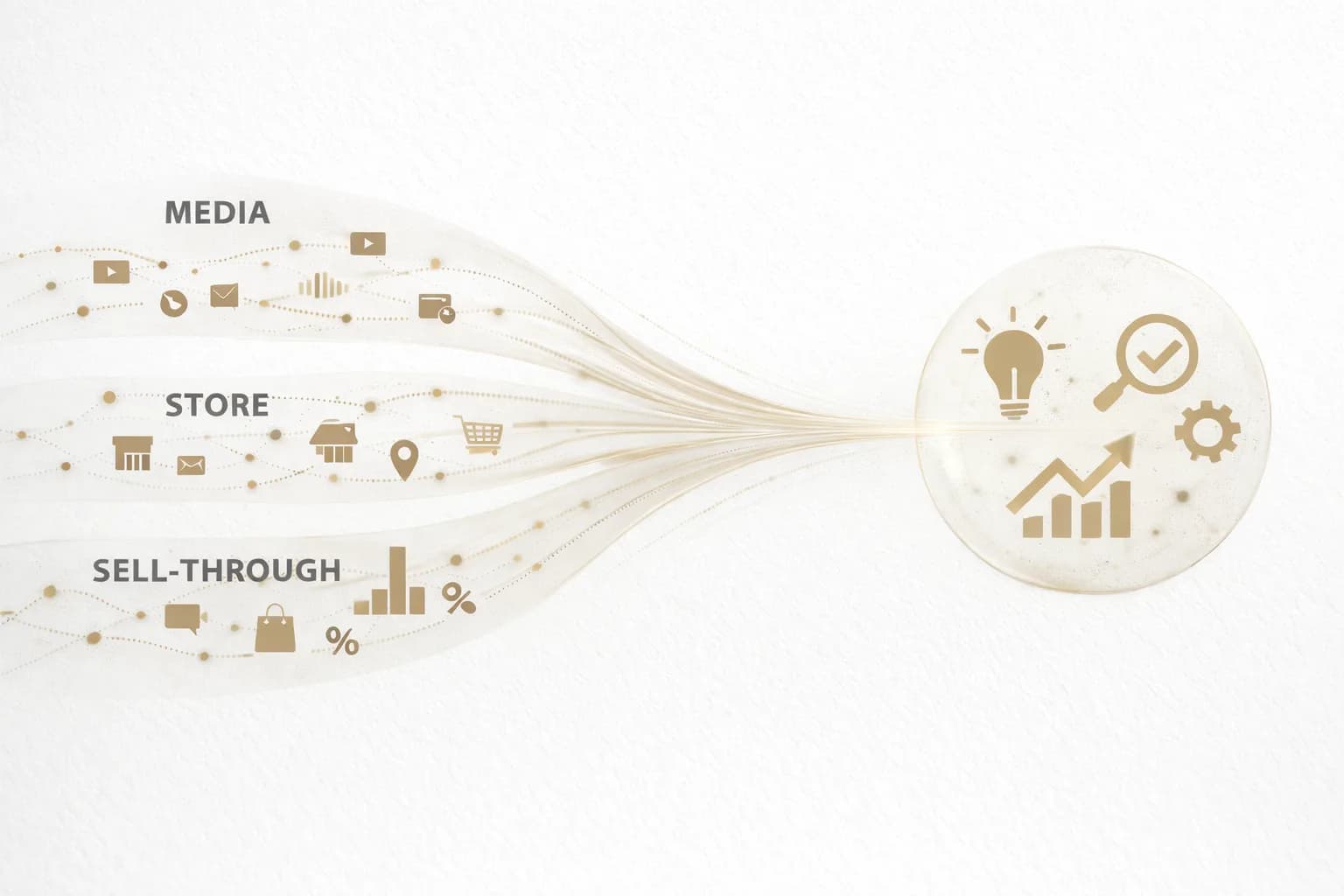
In a service-as-software behavioral intelligence platform, the system takes responsibility for the diagnostic chain: ingesting campaign data from multiple channels, connecting it to commercial sell-through outcomes, applying causal inference methods to isolate what drove the result, and returning a structured explanation with direction on what should change. The team's job is to review the output and act on it, not to perform the analysis that produces it.
This is not a subtle difference in how the interface looks. It is a different definition of what the product does. The team is not operating a tool. The system is delivering intelligence.
What this means for how brands should evaluate and buy intelligence platforms
The SaaS-to-service-as-software shift creates a specific evaluation problem for buyers. The questions that were appropriate for buying a reporting tool are not the right questions for buying an outcome-delivery system.
For a reporting tool, the relevant questions are access and feature questions. How many data sources can it connect? How customizable are the dashboards? How many seats are included? What integrations are available?
For a service-as-software intelligence platform, the relevant questions are accountability and methodology questions. What analytical methods does the system use to produce its outputs, and are those methods appropriate for causal inference rather than pattern recognition? What data environments does the system connect — and critically, can it reach the offline commercial data that is the actual outcome variable for a brand selling through physical retail? What is the system responsible for when the diagnosis is wrong — and how does the vendor define correctness?
Bain's Technology Report 2025 summarizes the shift in vendor accountability directly: SaaS leaders should "price for outcomes, not log-ons." The implication for buyers is the inverse: when evaluating vendors, ask what outcome they are committing to deliver, not what features they are providing access to.
For brands purchasing campaign intelligence, the practical version of this question is: can your system tell me why my offline sell-through moved the way it did after my last campaign, and what I should do differently next time? If the answer requires the buyer's team to perform substantial analytical work on top of the platform's outputs, it is a SaaS product regardless of what the marketing page calls it. If the answer comes from the system as a structured, actionable explanation based on causal analysis — that is service as software.
Where the enterprise software market is heading
Several structural forces are converging to accelerate the SaaS-to-service-as-software transition across enterprise software broadly.
The agent economics shift. When one AI agent can perform the work that previously required ten human users of a platform, seat-based pricing loses its proxy relationship with value delivered. MindStudio's April 2026 analysis documents this directly: SaaS companies with heavy enterprise per-seat exposure saw their revenue multiples compress in 2024-2025 relative to companies that had moved toward consumption or outcome-based models. Analysts began explicitly calling out "AI seat risk" as a valuation concern.
The outcome accountability shift. As L.E.K. Consulting's analysis describes: in some sectors, we are already seeing the rise of service-as-software models where outcomes matter more than interfaces. The companies that fail to shift from tool-provision to outcome-delivery risk being outpaced by a new class of competitors who never built a SaaS business model in the first place.
The data visibility shift. Outcome-based pricing has historically been constrained by the difficulty of measuring and attributing outcomes. As AI improves the ability to connect data environments, apply causal inference, and produce auditable, methodology-grounded explanations of commercial results, the measurement problem becomes more tractable — and outcome-based accountability becomes feasible at operating speed.
EY's 2025 analysis of the SaaS-to-agentic-AI transition puts the strategic imperative plainly: companies that stick with traditional subscription models risk losing to competitors that better align price to value received. The companies that succeed will use the AI transition to embrace a fundamentally different customer relationship — becoming partners in commercial outcomes rather than vendors of software access.
What Veinera represents in this context
Veinera was not built as a dashboard with AI features added. It was built as an outcome-delivery system for a specific commercial problem: connecting online campaign signals to offline sell-through outcomes using causal inference methods, and returning that connection as structured direction for the teams making campaign and investment decisions.
The analytical chain — from campaign data ingestion through causal modeling to explanation output — is owned by the system. The team receives a diagnosis and a direction, not a set of metrics to analyze.
This places Veinera structurally in the service-as-software category for behavioral intelligence. The value is not in the seats or the dashboards. The value is in the quality of the diagnosis and the accuracy of the causal methods that produce it.
The pricing model reflects this. The Core and Advanced tiers are subscription-based and appropriate for teams beginning to build the diagnostic infrastructure. The Enterprise tier, built around custom integrations, dedicated onboarding, and SLA commitments, is the model closest to the outcome-delivery accountability that full service-as-software requires. The direction over time is toward what Bain and EY and L.E.K. are each describing from their own analytical vantage points: pricing for commercial results, not log-ons.
The question every brand should now be asking their analytics vendors
The SaaS model asked vendors to deliver access and uptime. The service-as-software model asks vendors to deliver results.
The question every brand should be asking their campaign analytics and intelligence vendors in 2026 is not: how good are your dashboards?
It is: what are you responsible for delivering, and how do you know when you have delivered it?
The vendors who can answer that question with methodological specificity — not with feature lists, not with interface screenshots, not with customer logos — are the ones building in the right direction.
The vendors who cannot are still selling SaaS in a market that is moving toward something structurally different.
Sources and references
- Fortune Business Insights / Modall. Global SaaS market: $315.68 billion in 2025, growing at approximately 20% CAGR, projected to exceed $1 trillion by 2032.
- Thoughtworks. Service-as-Software: A New Economic Model for the Age of AI Agents. Definition and structural distinction between SaaS and service as software. December 2025.
- Bain & Company. Will Agentic AI Disrupt SaaS? Technology Report 2025. Three-layer stack architecture; recommendation to shift pricing from seat-based to outcome-based; "price for outcomes, not log-ons."
- Getmonetizely. SaaS Pricing Benchmark Study 2025. Analysis of 100+ B2B SaaS companies: per-user pricing down to 57% from 64%; usage-based in 43% of models; 47% of companies exploring outcome-based pricing; 9% fully implemented.
- PricingSaaS 500 Index. Credit model adoption: 126% year-over-year growth in 2025.
- Gartner. Projection: over 30% of enterprise SaaS solutions incorporating outcome-based components by 2025, up from approximately 15% in 2022. Via Getmonetizely.
- Deloitte. 2025 Tech Value Survey. 57% of respondents allocating 21-50% of digital transformation budgets to AI automation; 20% investing 50%+.
- Mayer Brown. Contracting for Agentic AI Solutions: Shifting the Model from SaaS to Services. Analysis of BPO-style contracting implications for agentic AI. February 2026.
- L.E.K. Consulting. Revolution or Extinction? Rethinking SaaS in the Age of Agentic AI. Service-as-software models and outcome-first workflows. July 2025.
- EY. Agentic AI: How SaaS Companies Can Embrace the Future. Outcome-based pricing models; shift from vendor to partner relationship. February 2026.
- MindStudio. SaaS Pricing Is Breaking: Why Per-Seat Models Don't Survive the AI Agent Era. Revenue multiple compression for per-seat SaaS companies; "AI seat risk" in analyst coverage. April 2026.
- Sergio Rio / Sergiorio.tech. The Service-as-Software Shift: Operationalizing the Agentic Enterprise. Locus of responsibility distinction between SaaS and SaS; outcome-based pricing mechanics. December 2025.
Veinera is built as a behavioral intelligence platform that delivers causal diagnosis of campaign performance — not a dashboard that requires your team to do the analysis. Want to see the distinction in practice? Book a 30-minute walkthrough with a Veinera specialist, tailored to your actual campaign environment, no commitment.
Related reading
- The AI feature problem — why bolting intelligence onto reporting does not produce intelligence · May 10, 2026
- Behavioral intelligence as a new decision layer · Apr 12, 2026
- Explanation over reporting — why analytics is due for a rewrite · Mar 28, 2026