Europe's measurement gap — why FMCG brands in Germany and the DACH region are flying blind on offline ROI
Germany is Europe's largest FMCG market, home to some of the most sophisticated consumer brands in the world. It also has the tightest regulatory constraints on digital attribution and the most consolidated offline retail structure of any comparable market. The combination creates an O2O measurement problem that is both structurally severe and commercially urgent.
Germany is Europe's largest FMCG market, home to some of the most sophisticated consumer brands in the world. It also has the tightest regulatory constraints on digital attribution and the most consolidated offline retail structure of any comparable market. The combination creates an O2O measurement problem that is both structurally severe and commercially urgent — and for which the standard measurement approaches are increasingly inadequate.
Campaign signals flow from digital platforms to a highly consolidated offline retail structure — separated by GDPR constraints that break user-level attribution in the middle.
The market that makes measurement hardest
Germany is not a soft market entry for FMCG brands. With grocery retail sales reaching approximately $293 billion in 2024, according to USDA data, it is the largest food retail economy in Europe. Consumer brands that want significant European FMCG revenue have to be in Germany. The question is not whether to compete there. It is whether they understand what is driving commercial performance when they do.
Most do not — and the reasons are structural, not operational.
Two forces converge in Germany to create an offline ROI measurement problem more severe than in most comparable FMCG markets: extreme retail consolidation, and the most stringent data privacy regulatory environment in the developed world. Each force creates measurement constraint on its own. Together, they produce a situation where brands are running substantial digital campaign investment into an offline commercial outcome they cannot see, using attribution methods that are legally restricted in the country where they most need them.
This is what flying blind on offline ROI looks like in Europe.
The retail concentration reality
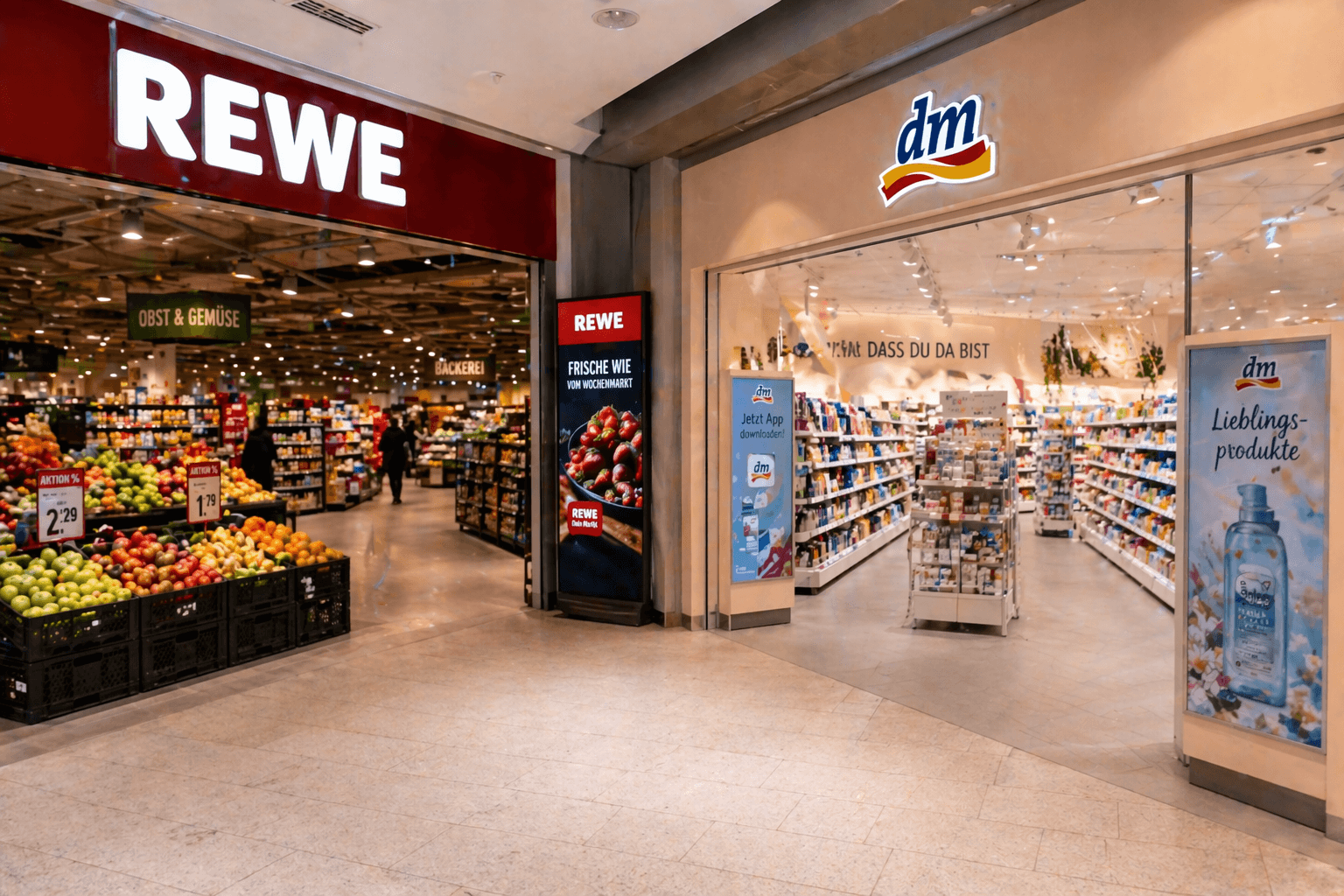
Germany's grocery retail structure is extraordinarily concentrated. Three groups — EDEKA, REWE, and the Schwarz Group (Lidl and Kaufland) — account for 64.8% of the national food retail market. Add Aldi and the picture is even more complete: the top four players control the significant majority of national grocery turnover.
The scale of each is striking. EDEKA, Germany's largest food retailer, reported group sales of €75.3 billion in 2024 across more than 10,800 stores. REWE Group posted €96.1 billion in total revenue in 2024, with its German retail division generating €41.63 billion. The Schwarz Group — Lidl and Kaufland — reported worldwide revenue of €175.4 billion in 2024; Lidl alone operates over 3,200 stores in Germany and reported 5.7% domestic sales growth in 2024, outperforming rivals.
For any FMCG brand selling through German retail, these three groups are not optional distribution channels. They are the market.
This consolidation creates a specific problem for campaign measurement. When a brand runs a digital campaign in Germany — across Meta, TikTok, Google, or programmatic — and wants to know what it produced commercially, it is asking what effect the campaign had on sell-through at EDEKA, REWE, Lidl, Kaufland, Aldi, and dm. The answer lives in those retailers' systems. The data is owned by them, structured for their internal purposes, and released to brands — when released at all — in aggregated weekly or monthly sell-through reports that were never designed for campaign attribution.
The measurement infrastructure on the digital side is sophisticated. The commercial outcome data on the offline side is sparse, lagged, and disconnected. The gap between them is where FMCG brands in Germany lose their understanding of what their campaigns actually produce.
What GDPR does to the measurement gap
GDPR was signed into law in 2018 and has shaped German digital advertising practice more consequentially than in any other major FMCG market. Germany's data protection authorities — particularly the Bundesdatenschutzbeauftragter and the Landesbeauftragten — have historically applied stricter interpretations than regulators in most other EU member states. Companies face potential fines reaching €22 million or 4% of global annual turnover for violations, and the practical effect on digital advertising infrastructure has been significant.
The most immediate consequence for measurement is the breakdown of user-level attribution. GDPR restricts the collection and processing of personal data without explicit consent. Consent rates for tracking cookies in Germany are among the lowest in Europe — and when consent is not granted, the tracking signals that standard digital attribution relies on are not available. As Usercentrics' analysis of GDPR's marketing impact notes: when tracking is restricted, attribution models can break.
They break specifically in Germany. A brand running campaigns across Meta and Google in Germany, relying on click-based attribution for performance measurement, is receiving a systematically degraded signal in this market. The fraction of user journeys that are fully trackable is lower than the brand's reporting dashboards indicate. The ROAS figures that platforms report are based on the users who did consent and whose journeys were traceable — not on the population of users who saw the campaign and eventually made a purchase decision.
The practical implication: campaign ROI calculated from standard digital attribution in Germany undercounts the campaign's actual commercial effect — and does so unevenly across channels, because consent rates differ by platform and by audience segment. A brand optimizing its German campaign budget based on platform-reported attribution is making allocation decisions from a systematically biased input.
This is not a German-specific problem in its nature. GDPR applies across the EU. But Germany's regulatory culture and the strictness of its implementation make the signal degradation more pronounced here than in most comparable markets.
The DACH confidence crisis in measurement
The measurement constraint is not invisible to the brands operating in it. Artefact DACH's research on marketing measurement in the German-speaking region documents both the awareness and the inadequacy of current responses.
Their findings are striking in their specificity. 70% of marketing executives still struggle to accurately measure and optimize the return on investment of their marketing campaigns. Critically, 60% of marketing leaders in the DACH region lack confidence in their ability to design effective experiments — the A/B tests, holdout tests, and geo-experiments that would provide the causal grounding for their measurement frameworks. And 70% say they are using rule-based attribution only — last-click, first-click, or time-decay models that were not designed for causal inference and that break most severely in exactly the GDPR environment Germany creates.
An internal satisfaction survey of marketing managers across DACH industries found that nearly 25% are dissatisfied with their current ROI measurement capabilities, and only 30% consider their current capabilities satisfactory and on the right track.
The gap between the sophistication of the brands in this market and the adequacy of their measurement infrastructure is real and documented. One Artefact research participant — an international media buyer at a German travel agency — described the situation with unusual directness: "We are aware of the measurement problem, but we don't know how to solve it."
That is not a capabilities crisis. It is a structural one. The tools brands are using were not built for this measurement environment. They were built for markets where user-level tracking is more available, where offline sell-through data connects more easily to digital campaign signals, and where the causal question can be answered through methods that GDPR has degraded in Germany.
Why FMCG is growing fastest online while measuring it worst
The timing of this measurement crisis is particularly acute because FMCG in Germany is undergoing its fastest digital growth in years — precisely when measurement is most constrained.
FMCG recorded the strongest online growth of any product category in Germany at 7.3% in 2024, according to the German Retail Association (HDE) analysis compiled by Cross-Border Magazine. The HDE's updated 2025 forecast for FMCG e-commerce growth reached 14.6% — the highest projected growth rate of any category in a market that is itself expected to reach €92.4 billion in online retail revenue in 2025.
The structural drivers are clear: convenience, subscription models for recurring purchases, quick commerce services, and the shift of FMCG consumer behavior toward online discovery even when purchase completes offline. The consumer journey for a German FMCG purchaser in 2026 increasingly starts with digital exposure — on TikTok, Meta, or a retail media network — and completes in an Edeka, a Rewe, or a dm pharmacy.
That journey — digital discovery, offline completion — is exactly the signal chain that needs measurement. And it is the signal chain that GDPR-constrained user-level attribution cannot follow.
Germany is the market where FMCG digital investment is growing fastest. It is also the market where the measurement infrastructure for that investment is structurally most inadequate. Brands are accelerating campaign spend into a measurement vacuum.
Why the standard solutions fall short here
The two most commonly proposed solutions to the GDPR-era measurement problem — first-party data strategies and marketing mix modeling — are both relevant in Germany but neither solves the offline sell-through attribution problem on its own.
First-party data addresses the consent problem for brands that have direct consumer relationships — loyalty programs, subscription services, owned e-commerce channels. But most FMCG brands in Germany do not have direct consumer relationships at the point of purchase. They sell through EDEKA, REWE, Lidl, and dm. Their customer data lives in the retailer's systems, behind the retailer's data governance framework. First-party data strategies strengthen what a brand can measure about its direct channels. They do not solve the offline sell-through attribution problem.
Marketing mix modeling (MMM) is experiencing a genuine resurgence specifically because it is privacy-safe — it works with aggregated, market-level data rather than user-level tracking, making it compliant with GDPR by design. As Circana's analysis of MMM notes: it utilizes data above the user level, ensuring privacy compliance while capturing the full scope of marketing effectiveness. The Artefact DACH research shows that only a tiny fraction of DACH marketers are using a unified approach combining MMM with attribution and incrementality testing — a gap that represents a real capability advantage for brands that do.
But standard MMM faces the same offline data constraint that all O2O measurement approaches face in Germany: it can only incorporate sell-through data that brands actually have access to. For FMCG brands selling through Germany's highly consolidated retail chains, the retailer controls the sell-through data. MMM built without that data produces insights about media mix efficiency and channel contribution — but not about the relationship between campaign signals and physical retail outcomes.
The measurement problem in Germany is not solved by privacy-compliant digital attribution. And it is not solved by MMM built without offline retail sell-through data. It requires both: a causal inference approach that is privacy-safe by design, and the operational connections to retailer sell-through data that give the model the commercial outcome signal it needs to answer the right question.
The specific measurement problem for beauty and wellness brands in DACH
The case for behavioral intelligence in Germany is most acute for brands in the beauty, wellness, and personal care categories — precisely the categories where Veinera is entering the European market.
These categories are undergoing their own structural shift. TikTok launched a GDPR-compliant measurement solution specifically for European markets in November 2024, enabling campaign attribution without personal data. This signals where the demand is: beauty and wellness brands are running TikTok and creator-driven campaigns at scale in Germany, and they need GDPR-compliant ways to connect those campaigns to commercial outcomes.
The commercial outcomes, however, are not primarily on TikTok. They are at dm, Rossmann, Douglas, REWE's health and beauty section, and the dm.de and Rossmann.de e-commerce channels. A brand running a TikTok creator campaign for a skincare product in Germany is generating demand that distributes across all of those channels. The TikTok measurement — even GDPR-compliant — tells the brand what happened on the platform. It does not tell the brand what happened at dm in the following two weeks.
That is the sell-through question in Europe. It is structurally identical to the question Veinera is answering in Indonesia, and it requires the same analytical approach: geographic causal inference methods applied to campaign exposure patterns and regional retailer sell-through data, connected through an operational infrastructure that neither the brands nor the retailers have built independently.
Why Germany is the right European entry point
Germany's measurement problem is severe enough to create urgent commercial demand for a solution. The concentration of FMCG market power in a small number of retail chains means the sell-through data — when accessible — is meaningful and representative rather than fragmented. The GDPR constraint means that any valid measurement approach must be privacy-safe by design, which points directly toward the geographic causal inference methods Veinera uses rather than away from them.
The sophistication of the brand ecosystem — Beiersdorf, Henkel, Schwarz Group's private label operations, the international FMCG brands with major German retail presence — means the commercial value of a working measurement system is large. A 10-15% improvement in budget allocation efficiency for a brand spending €50 million annually on German retail media represents €5-7.5 million in recovered value. That value case is not abstract — it is the documented outcome of connecting digital campaign signals to offline commercial outcomes with sufficient causal rigor to make allocation decisions confidently.
The DACH market is where Veinera's European thesis begins. The infrastructure built to close the measurement gap here — privacy-safe causal inference, operational connections to consolidated retailer sell-through data, behavioral attribution across the full campaign chain — is the same infrastructure that extends into Austria, Switzerland, and the broader European FMCG market.
The measurement problem is real, documented, and urgent. The analytical approach to solving it is available. The market is ready for the layer that connects them.
Sources and references
- USDA. Retail Foods Annual, Germany 2025. German grocery retail sales: approximately USD 293 billion in 2024. Berlin, Germany.
- BVE / Statista. Market share of leading companies in German food retail: EDEKA 25.3%, Schwarz Group (Lidl/Kaufland), REWE. Data 2023, published July 2024. Three groups collectively: 64.8% market share (DataPulse Research).
- ESM Magazine. Top 10 Supermarket Retail Chains in Germany. EDEKA €75.3B (2024); REWE €96.1B total / €41.63B Retail Germany (2024); Schwarz Group €175.4B worldwide (2024). February 2026.
- E-Commerce Germany News. Top Supermarket Chains in Germany 2026-2030. Lidl Germany: 3,200+ stores, 5.7% sales growth in 2024. January 2026.
- Grocery Trade News. German Grocery Market Share 2025. Discounters accounting for roughly half of total grocery spending. February 2026.
- Artefact DACH. Navigating the Complex Landscape of Marketing ROI. DACH-specific data: 70% of marketing executives struggle to measure and optimize ROI; 60% of marketing leaders in DACH lack confidence in experiment design; 70% use rule-based attribution only; 25% dissatisfied with ROI measurement capabilities; 30% consider capabilities satisfactory. September 2024.
- Cross-Border Magazine. Germany's E-Commerce Forecast Raised to €92.4 Billion for 2025. FMCG: strongest online growth at 7.3% in 2024; 14.6% projected 2025 growth. July 2025.
- HDE (Handelsverband Deutschland). German online retail market: €88.8 billion in 2024, forecast €92.4 billion in 2025.
- Ken Research. Germany Digital Media and Advertising Tech Market. GDPR fines reaching up to €22 million or 4% of global turnover; GDPR limiting advertisers' ability to target consumers effectively.
- Usercentrics. Navigating GDPR and Marketing: Guide for 2025. GDPR breaking attribution models when tracking is restricted.
- Circana. Marketing Mix Modeling Insights. MMM as privacy-safe alternative that works with aggregated, market-level data; ability to establish causality rather than correlation.
- Statista. Germany advertising market: $28.78 billion in 2025. Germany Advertising Market Forecast.
- TikTok for Business / Market Data Forecast. Europe Digital Advertising Market. TikTok launched GDPR-compliant measurement solution in collaboration with European verification vendors, November 2024.
Veinera is entering the European market in 2027, with Germany as its lighthouse market. If you are a consumer brand or agency operating in DACH and want to understand the measurement approach, we are opening limited early conversations with brands evaluating this capability ahead of launch.
Related reading
- The offline data desert — why the most valuable behavioral signal is the hardest to reach · Apr 19, 2026
- Why Indonesian brands are sitting on the most complex O2O problem in the world · May 3, 2026
- The AI feature problem — why bolting intelligence onto reporting does not produce intelligence · May 10, 2026