TikTok Shop Europe — the measurement problem just got a new geography
On March 31, 2025, TikTok Shop launched in Germany, France, and Italy simultaneously, giving over 72 million users across three of Europe's largest economies access to in-app shopping for the first time. Within a year, TikTok Shop had become the fifteenth most popular online marketplace in Germany by revenue. The channel is real, the demand it generates is real — and the measurement infrastructure European brands need to understand what it actually produces commercially does not yet exist.

On March 31, 2025, TikTok Shop launched in Germany, France, and Italy simultaneously, giving over 72 million users across three of Europe's largest economies access to in-app shopping for the first time. NIVEA launched on day one. Carrefour launched in France. Within a year, TikTok Shop had become the fifteenth most popular online marketplace in Germany by revenue. The channel is real, the demand it generates is real — and the measurement infrastructure European brands need to understand what it actually produces commercially does not yet exist. This is the Southeast Asia O2O problem, arriving in Europe, inside GDPR constraints, in real time.
TikTok Shop generates demand across Europe. The platform measures what completes inside it. What happens at dm, Rossmann, Douglas, and Carrefour in the days that follow is structurally invisible.
What happened on March 31, 2025
The date is specific because the market context matters. TikTok Shop launched simultaneously in Germany, France, and Italy on March 31, 2025 — nearly a year after the planned summer 2024 European expansion was paused while TikTok prioritized its US market position. The delay made the eventual launch more deliberate: brands, logistics infrastructure, and creator ecosystems were in place from day one.
Germany launched with 24.2 million monthly TikTok users gaining in-app shopping access. France and Italy brought the combined figure to over 72 million users across the three new markets. The launch roster included names that signal the channel's commercial seriousness: NIVEA (Beiersdorf), Cosnova cosmetics (the German company behind essence and Catrice), About You, and in France, Carrefour — one of Europe's largest retail groups.
Beiersdorf had been on TikTok's commerce infrastructure before this. The company entered Douyin (TikTok's Chinese equivalent) in 2020, Southeast Asia in 2023, the US and Spain in 2024. Germany on March 31, 2025 was the next chapter of a deliberate international social commerce strategy. Christian Haensch, General Manager for Germany and Switzerland at Beiersdorf, described the logic: "E-commerce is already the fastest-growing sales channel for Beiersdorf, and with TikTok Shop, we are now taking this development even further, harnessing the potential of social commerce in Germany."
By the time a year had passed, 15% of all German consumers had already shopped on TikTok Shop, and the platform had become the fifteenth most popular online marketplace in Germany by revenue, according to GlobalEyez research. Public First estimated that TikTok added approximately €31 billion to the EU economy in 2025. The next wave of European expansion — Netherlands, Belgium, Poland, and Sweden — is already in motion for 2026.
The channel has arrived. The measurement problem arrived with it.
What TikTok Shop Europe actually measures
Before mapping the measurement gap, it helps to be precise about what TikTok Shop does measure well. For transactions that complete inside the platform — a consumer sees a creator's video, taps the product link, adds to cart, and checks out — the attribution data is relatively complete. View-through rates, click-through rates, add-to-cart events, and in-app purchases are all captured within TikTok's analytics environment.
TikTok launched a GDPR-compliant measurement solution for European markets in November 2024, enabling campaign attribution without relying on personal data. This was a genuine step forward: it means brands can measure in-platform performance in Europe without the user-level tracking restrictions that make standard digital attribution unreliable in GDPR environments.
The limitation is the same one that characterizes retail media's closed loop and every other ecosystem-specific measurement architecture: the loop closes inside the platform. What happens outside it — at physical retail, on competing e-commerce platforms, through distributors — is invisible to TikTok's analytics regardless of how GDPR-compliant the in-platform measurement becomes.
Research from Precis, analyzing TikTok campaign performance across ten Nordic e-commerce brands using Bayesian MMM methodology, found that traditional last-click attribution undervalues TikTok's ROI by an average of 10.7 times. The delta exists because TikTok is primarily an upper and mid-funnel channel — it creates awareness and consideration that converts through other channels, at later times, in ways that last-click attribution cannot see. Brands using TikTok Shop's native analytics to evaluate campaign performance are measuring the conversion that completed inside TikTok while missing the commercial contribution that completed everywhere else.
The same research found that 45% of brands saw statistically significant lifts in brand search impressions within one to two months of launching TikTok campaigns — a halo effect that shows up in organic search and other channels, not in TikTok Shop GMV. The demand TikTok creates extends well beyond what TikTok captures.
The European O2O gap in practice
For a beauty or wellness brand running creator campaigns on TikTok Shop Germany, the commercial landscape looks like this.
The TikTok campaign creates demand across 24.2 million German TikTok users. Some fraction of them will see a creator demo of a skincare product, develop purchase intent, and act on it. The routes they take to purchase are multiple, simultaneous, and structurally unconnected in any current measurement system.
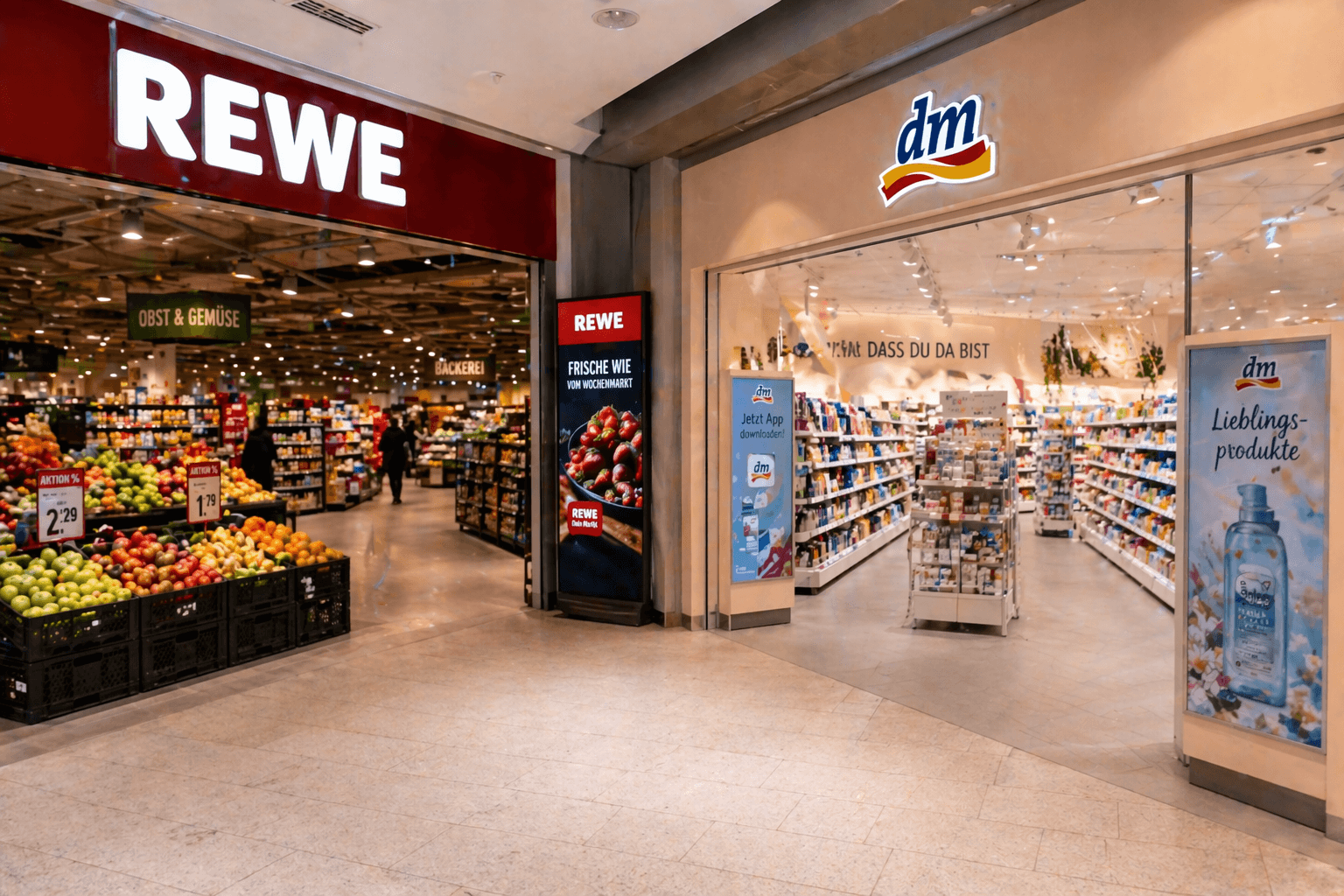
A consumer who completes the purchase on TikTok Shop generates a transaction that TikTok's analytics captures. A consumer who sees the creator video, browses to dm.de, and orders for click-and-collect generates a transaction that dm's own systems capture — but not in a form that connects back to the TikTok exposure. A consumer who walks into a Rossmann the following Saturday and buys the product off the shelf generates a point-of-sale transaction that appears in Rossmann's sell-through data — separated from the TikTok campaign by geography, time, and organizational ownership of the data.
This is the O2O gap in European social commerce. The demand signal is on TikTok. The purchase completion distributes across TikTok Shop, Amazon.de, dm, Rossmann, Douglas, Müller, Sephora, REWE's health and beauty section, and independent pharmacies. TikTok's analytics see the first. The rest is a distribution of commercial outcomes that no current measurement system connects back to the campaign that generated them.
Beiersdorf is a useful case precisely because its commercial footprint demonstrates the gap's scale. NIVEA is not a TikTok-native brand selling primarily through social commerce. It is one of the most widely distributed consumer goods brands in Germany, available at dm, Rossmann, Rewe, Edeka, Kaufland, and every pharmacy chain in the country. When a TikTok creator campaign for a NIVEA suncare SKU generates views, engagement, and in-platform purchases, it simultaneously generates awareness and consideration that affects consumer behavior at every one of those offline channels. The TikTok Shop analytics show what happened on TikTok. The question of what happened to NIVEA sell-through at dm in the subsequent three weeks, in the regions where the creator's audience was concentrated, remains unanswered.
Why GDPR makes the gap structurally worse in Europe than in Southeast Asia
Veinera documented the O2O measurement problem in Southeast Asia in earlier entries in this series. The structure is the same in Europe, but two features of the European regulatory environment amplify its severity.
First, GDPR's constraints on user-level tracking limit the cross-platform attribution methods that brands in less regulated markets can use to bridge the online-to-offline gap. In Indonesia, brands can use device-level identity matching, location data partnerships, and third-party audience resolution tools to connect TikTok exposure signals to physical retail behavior. In Germany, these approaches face significant legal constraint. The result is that the already-difficult task of connecting TikTok creator content exposure to offline purchase behavior is further constrained by the regulatory architecture of the market where many of Europe's most valuable FMCG brands operate.
Second, the EU Digital Services Act and platform transparency requirements create additional compliance overhead that shapes how TikTok can instrument its own measurement in the European market. TikTok's GDPR-compliant measurement solution for Europe is a genuine step toward closing the in-platform attribution gap. It does not address the offline sell-through gap, which is a data governance and causal inference problem rather than a platform compliance problem.
The combination — strong creator-driven demand generation platform, robust GDPR restrictions on cross-platform tracking, and a highly concentrated offline retail environment (as documented in Blog 09's analysis of German grocery consolidation) — creates a measurement environment where the commercial outcome of TikTok investment is harder to see in Europe than almost anywhere else that TikTok Shop operates.
This is not a reason to avoid the channel. It is a reason to build the right measurement infrastructure before scaling investment in it.
What the measurement infrastructure needs to provide
The measurement challenge that TikTok Shop Europe creates for FMCG and beauty brands is analytically identical to the one Veinera was built to address in Southeast Asia, with the European regulatory context adding complexity rather than changing the fundamental problem.
Closing the loop between TikTok creator content exposure and European offline retail sell-through requires four connected components.
Creator campaign geographic exposure patterns. Which creator audiences, in which German, French, or Italian cities and regions, saw what content, at what intensity, over what time period. This is available from TikTok's analytics at the aggregate level and from creator partnership data at the audience demographic level. Mapping it to geographic regions creates the exposure variable for causal analysis.
Cross-platform e-commerce sell-through. What the brand sold on TikTok Shop, Amazon.de, dm.de, and other e-commerce platforms in the same period and geography. This represents the measurable digital sell-through component, though not the complete picture.
Physical retail sell-through at regional level. What the brand sold through dm, Rossmann, Douglas, Müller, Rewe, and other physical retail partners in the weeks following campaign exposure, at regional granularity. This data is available from retailer sell-through reports and distributor records, but arrives in formats not designed for campaign attribution.
Causal inference methods that separate campaign effect from baseline. Geographic difference-in-differences applied to the treatment regions where creator campaign exposure was dense versus the control regions where it was sparse — holding constant the product's normal sell-through trajectory. This is the analytical method that produces a causal estimate of campaign contribution to commercial outcomes, rather than a correlation observation that cannot distinguish campaign effect from simultaneous market factors.
The exact approach documented in Blog 06 (Indonesia O2O complexity) and Blog 09 (Germany DACH measurement gap) applies directly to TikTok Shop Europe. The geography is different. The regulatory environment adds constraints. The analytical solution is the same.
Why this matters most for beauty and wellness brands right now
TikTok Shop's European performance follows the pattern established in the US and Southeast Asia: beauty and personal care is the dominant category. NielsenIQ's research found that TikTok Shop was the eighth-largest e-commerce health and beauty retailer in the US in 2024, with 200% year-over-year sales growth making it the fastest-growing e-commerce channel in the category during the 2024 holiday season.
The European trajectory mirrors this. Beauty products are among the most popular categories on TikTok Shop Germany, France, and Italy from launch. Brands like essence, Catrice, L'Oreal, and Beiersdorf are all active on the platform precisely because beauty is where TikTok's creator-to-commerce funnel is most effective.
The same features that make beauty so well-suited to TikTok commerce — demonstrable products, trust-driven purchase decisions, peer recommendation power, affordable price points that support impulse purchase — are the features that make the O2O measurement gap most commercially significant. A beauty consumer who sees a creator skincare routine, develops preference for a specific product, and then makes that purchase at dm three days later represents commercial value that TikTok Shop analytics cannot see. Multiplied across the 24.2 million German TikTok users and the brands with distribution across both TikTok Shop and German physical retail, the measurement gap is substantial.
The brands that can connect their TikTok creator campaigns to sell-through outcomes across the full European retail footprint — not just what completes on TikTok Shop — will allocate their social commerce budgets with a precision that their competitors cannot match from platform analytics alone.
That precision is what the measurement infrastructure for TikTok Shop Europe needs to provide, and what no current platform or standard attribution approach can deliver.
Sources and references
- E-Commerce Germany News. TikTok Shop Expands to Germany, France and Italy. Launch date March 31, 2025; 24.2 million monthly German TikTok users; launch brands including NIVEA (Beiersdorf), Cosnova, About You. January 2026.
- WWD / Women's Wear Daily. As TikTok Shop Expands in Europe, Will It Unlock New Opportunities for Beauty Brands? Beiersdorf/NIVEA launch statement from Christian Haensch. TikTok Shop US: $1 billion in beauty sales in 2024; eighth-largest e-commerce health and beauty retailer (NielsenIQ). April 2025.
- GlobalEyez. TikTok Shop Enters Europe. 15% of all German consumers have already shopped on TikTok Shop; platform became 15th most popular online marketplace in Germany by revenue. Well-known brands active: L'Oreal, Beiersdorf, Pepsi, WMF. October 2025.
- Helm WMS. TikTok Shop's European Expansion. Over 72 million users across Germany, France, and Italy gained access; Carrefour launched in France on day one. April 2025.
- Public First. TikTok added approximately €31 billion to the EU economy in 2025. Via 10X Crew, February 2026.
- Precis / TikTok / Alvie. TikTok Strategy 2025: A Research-Backed Playbook for E-commerce Marketing. Traditional attribution undervalues TikTok ROI by average 10.7x; 45% of brands saw statistically significant lifts in brand search impressions within 1-2 months of TikTok campaign activation; UGC outperformed non-UGC by 55% ROI. Study across 10 Nordic e-commerce brands, 2023-2024.
- Dataslayer. TikTok Shop Analytics 2025. 97% of TikTok Shop purchasers also shop on Amazon. Platform-exclusive measurement misses cross-channel commercial impact. TikTok default attribution: 7-day click, 1-day view.
- Nova Analytics. TikTok Shop Pitches Europe and Japan as Next $770B Growth Engine for 2026. TikTok Shop global GMV $33 billion in 2025; EU customs reform March 2026 (eliminating €150 de minimis exemption). April 2026.
- 10X Crew. TikTok Shop Europe 2026: Data and Seller Strategy. TikTok Shop live in UK, Germany, France, Italy, Spain, and Ireland in 2026; next expansion Netherlands, Poland, Belgium, Sweden. February 2026.
- Market Data Forecast / Europe Digital Advertising Market. TikTok launched GDPR-compliant measurement solution in Europe, November 2024.
Veinera is connecting TikTok creator campaign exposure to offline retail sell-through in European markets using causal inference methods designed for GDPR-compliant environments. If you are a beauty, wellness, or FMCG brand scaling TikTok Shop investment in Germany or Europe, book a 30-minute walkthrough — no commitment.
Related reading
- TikTok Shop, creator commerce, and the sell-through question no one is answering · Apr 26, 2026
- Why Indonesian brands are sitting on the most complex O2O problem in the world · May 3, 2026
- Europe's measurement gap — why FMCG brands in Germany and the DACH region are flying blind on offline ROI · May 24, 2026