The private label squeeze — why behavioral intelligence is the most important defense FMCG brands have right now
Private label has outpaced national brands in both dollar and unit sales growth for three consecutive years. In Europe, 84% of consumers say they will keep buying private label even when their purchasing power improves. The standard brand defense — more advertising, deeper promotions — is not working. The response that will work is more precise than that.
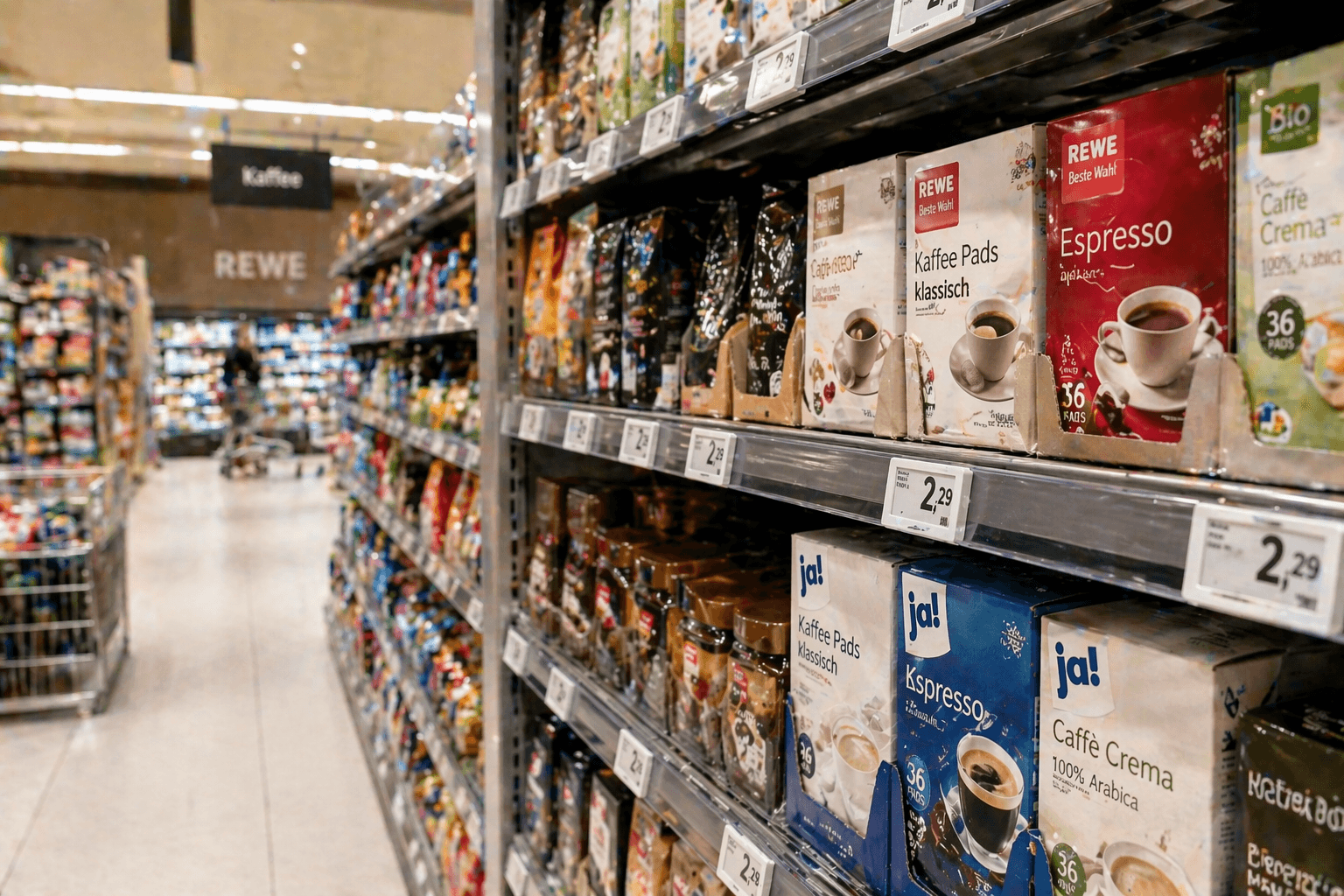
Private label has outpaced national brands in both dollar and unit sales growth for three consecutive years. In Europe, 84% of consumers say they will keep buying private label even when their purchasing power improves. In the US, national brands saw unit sales decline in the first half of 2024 while private labels grew. The standard brand defense — more advertising, deeper promotions — is not working. The response that will work is more precise than that. And precision requires knowing something most FMCG brands cannot currently see: exactly where private label is winning at the shelf, and which of their campaign investments are successfully defending against it.
The shelf decision moment — where brand campaign investment either translates to consumer preference or loses to the private label alternative — is the most commercially important moment in FMCG and the least measured one.
The scale of what has changed
The private label story in FMCG has crossed from "notable trend" to "structural reality" in the span of three years, and the data makes the scale of the shift difficult to minimise.
US private label sales reached $271 billion in 2024, growing 3.9% year-on-year, with projections toward $277 billion in 2025, according to the Private Label Manufacturers Association. For context, private label now captures over 20% of total US grocery value and close to 23% in unit share — and it has been growing at roughly twice the rate of national brands.
In Europe, where private label penetration has historically been higher, the numbers are more advanced and, for national brands, more sobering. Private label reached 39.1% of European grocery market share in 2024, according to McKinsey's State of Grocery Europe 2025 report. That figure is projected to reach 40 to 42% by 2030 at current trajectories.
The trend that was once explainable as inflation-driven trading-down has produced a finding that no FMCG brand strategist should overlook: 84% of European consumers say they will continue buying private label products even if their purchasing power improves, according to the same McKinsey research. This is not a temporary economic behavior. It is a permanent preference shift that has already moved faster in Europe than most market forecasts anticipated.
In the United States, McKinsey's November 2024 analysis put the perception data plainly: more than 80% of US consumers now rate private-brand food products as equal or better than national brands in quality, and nearly 90% believe private brands offer similar or better value. NIQ's 2024 Brand Score Study found that 60% of shoppers now trust store brands, and 71% rate them equal or better in quality compared to national brands.
The quality perception gap that national brands relied on as their primary defensive moat has effectively closed. The battle for consumer preference at the shelf is now being fought on different terrain.
What national brands are doing — and why it is not working
The standard FMCG brand response to private label encroachment has been two-pronged: maintain advertising investment to protect brand equity, and use promotional pricing to close the price gap with private label alternatives.
Both responses have real logic behind them. Brand advertising builds the mental availability and preference that primes consumers toward branded choices before they reach the shelf. Price promotions create purchase occasions that might otherwise go to private label alternatives. Neither is wrong in principle.
The problem is execution without feedback. Brands are running both responses without knowing which ones are working, in which markets, against which private label competitors, for which consumer segments. The promotional investment in particular has become self-defeating at scale. In the UK, 43% of FMCG units are sold on promotion — a figure that documents the depth to which discounting has become the primary brand defense mechanism. Continuous discounting erodes the premium positioning that justifies the brand's price point over private label. It trains consumers to wait for price reductions. It compounds the very problem it is trying to solve.
NIQ's 2024 research found that 53% of retailers expect private label to be their number one growth driver — which means the retailers who control shelf placement, promotional priorities, and store brand visibility are structurally incentivized to compete against the national brands they simultaneously stock. A brand negotiating promotional support from a retailer is negotiating with a party whose private label interests are directly opposed to the brand's market share objectives.
The response that is needed is more surgical than broad-based advertising or category-wide promotion. It requires knowing precisely where private label is winning — which SKUs, which retailer formats, which geographic markets — and which campaign investments are successfully defending brand preference at those specific moments of competitive pressure.
That is a behavioral intelligence problem. And most FMCG brands cannot currently solve it.
The shelf moment is where the decision is made — and where brands are flying blind
The commercial contest between national brands and private labels resolves at a single moment: the shelf. A consumer who is simultaneously aware of both options and has not yet committed makes a choice based on a combination of brand preference built upstream and the comparative signals available in front of them — price, packaging, placement, and whatever mental availability the brand's campaign investment created.
Campaign measurement tells brands what happened upstream of that moment: how many impressions were delivered, what creative resonance scores looked like, what platform-reported ROAS was generated. It does not tell brands what happened at the shelf moment itself. Whether the campaign translated to preference over the private label alternative. Whether the consumer who saw the creator campaign chose the brand or the private label. Whether the promotional mechanics that ran in the same period reinforced or undermined the brand's premium positioning.
This gap is not hypothetical. It is the reason brands are running expensive, well-researched campaign strategies and still watching private label unit share grow. The feedback loop between campaign investment and the commercial outcome it was designed to produce — brand preference at the physical point of purchase — does not exist in current measurement infrastructure.
What exists instead is a proxy chain: campaign generates awareness, awareness is assumed to build preference, preference is assumed to convert at the shelf. Each assumption is reasonable at the aggregate level and unreliable at the precision level. A campaign running nationally may be defending share effectively in urban centers where brand equity is higher and private label penetration is lower, while simultaneously failing to hold ground in suburban and rural retail environments where private label has higher placement priority and weaker brand counter-positioning. The national-level measurement says the campaign is performing. The market-level reality is that it is holding some ground and losing others.
The specific intelligence gap and what it costs
The intelligence gap for branded FMCG companies facing private label competition has three specific dimensions, each of which requires sell-through data connected to campaign signals to close.
Where exactly is private label winning? National brands typically have aggregate category share data from market research firms — how much of the category is branded versus private label across a market. What they rarely have is the geographic and retailer-level granularity to identify which specific retail environments are experiencing the fastest private label share gain, which SKUs are most vulnerable, and which consumer segments are switching earliest. Without this resolution, brand defense investment cannot be targeted.
Which campaign formats are successfully defending brand preference? A national advertising campaign, a creator commerce program, and a retail media buy are all simultaneously influencing the same consumer in the same period. None of them can individually tell the brand whether they are producing brand preference that holds at the shelf against a private label alternative — because none of them can see the shelf outcome. Sell-through data at the SKU and retailer level, connected to the geographic footprint of campaign exposure, is the only signal that can distinguish brand defense success from brand defense failure at the precision required to make allocation decisions.
What does the private label premium tier mean for positioning? Major retailers are no longer running single-tier private label strategies. Germany's Edeka operates Gut und Günstig for value shoppers, Genussmomente for premium occasions, MinusL for dietary restriction needs, and My Veggie for plant-based demand — four distinct private label tiers competing at every segment of the branded category. Walmart's Bettergoods, launched in 2024, approached nearly $500 million in sales in its first year and demonstrated that premium private label is a structural trend, not a category anomaly. A national brand that understands its competitive position only at the category level — not at the tier, retailer, and geographic level — is navigating a multi-dimensional competitive environment with a one-dimensional picture.
What behavioral intelligence provides that standard measurement cannot
The behavioral intelligence argument in the context of private label is not about generating more brand awareness data or more digital attribution data. It is about connecting the upstream campaign investment to the downstream commercial moment that determines whether brand or private label wins.
That connection requires three things working together.
Sell-through data at regional and retailer resolution. Not category share at the national level. The actual unit movement of the brand's SKUs, and where available the equivalent private label SKUs, at the retailer and regional level. This is the outcome signal that reflects what happened at the shelf moment — not what was predicted by upstream campaign metrics.
Geographic campaign exposure patterns. Where the brand's campaign investment was concentrated, at what intensity, in what format, over what time period. This is the input signal that can be connected causally to the sell-through outcome through geographic variation in exposure.
Causal inference methods that separate campaign effect from baseline. Private label share gains and branded share losses have multiple causes — retailer promotional strategy, economic pressure, category evolution, and the brand's own campaign investment or withdrawal. Identifying the specific contribution of campaign signals to sell-through outcomes requires methods that separate the campaign effect from all of these concurrent factors. Geographic difference-in-differences, applied to market pairs with different campaign exposure levels, is the approach that can produce this causal separation — not the correlation-based attribution models that standard campaign measurement provides.
When these three elements connect, a brand can answer the question that currently has no answer in most FMCG measurement stacks: which of our campaign investments are successfully defending brand preference over private label alternatives, in which markets, at which retailers, and for which consumer segments?
That question, answered at precision, changes the nature of the brand defense investment from broad-based insurance to targeted intervention — concentrated in the markets and retail environments where private label pressure is highest and campaign defense is most effective.
The window for action is shorter than most brands recognize
Private label is not a problem that reached a stable ceiling in 2024 and will stay there. McKinsey's State of Grocery Europe projection — 40 to 42% private label share in European grocery by 2030 — and the Kearney projection that private label will capture an additional 7 percentage points of US dollar market share from national brands by 2030 — both suggest the trajectory has years of momentum remaining.
The brands that will successfully defend their positions are not the ones that spend the most on brand advertising in aggregate. They are the ones that can direct that investment with enough precision to identify and protect the specific commercial moments where brand preference is being decided.
The brands that build the capability to connect campaign signals to sell-through outcomes at market and retailer level — that can see where private label is winning at the shelf and which of their campaign investments are effectively defending against it — will have a structural measurement advantage that compounds over time.
The brands that continue running broad campaign measurement and hoping the aggregate metrics reflect local commercial reality will continue losing ground to private label alternatives that their measurement infrastructure cannot see clearly enough to defend against.
Sources and references
- Private Label Manufacturers Association (PLMA). US private label sales: $271 billion in 2024 (up 3.9% YoY), projected $277 billion in 2025. Unit sales up 1.1% in 2024; national brands flat or slightly negative.
- McKinsey. State of Grocery Europe 2025. European private label: 39.1% grocery market share in 2024, projected 40-42% by 2030. 84% of European consumers say they will continue buying private label even if purchasing power improves. April 2025.
- McKinsey. A Turning Point for Private Brands. More than 80% of US consumers rate private-brand food quality equal or better than national brands; nearly 90% believe private brands offer similar or better value. November 2024.
- McKinsey. State of Food and Beverage. Walmart's Bettergoods: approximately $500 million in sales in first year after launch. Germany's Edeka private label portfolio: Gut und Günstig, Genussmomente, MinusL, My Veggie. April 2026.
- NIQ. Finding Harmony on the Shelf: 2025 Global Outlook on Private Label and Branded Products. 53% of global respondents increasingly purchasing more private label; 53% of retailers expect private label to be their number one growth driver. March 2025.
- NIQ / Brandbank. 2024 Brand Score Study. 60% of shoppers trust store brands; 71% rate them equal or better in quality compared to national brands.
- Sevendots. US private label value share over 20% in H1 2024; unit share close to 23%; growth rate twice that of branded products. First six months 2024.
- Simon-Kucher. Private Labels on the Rise: Consumer Trends Reshaping the Food and Drugstore Market. Survey of 8,000 consumers across 7 countries: 53% choose private labels predominantly or exclusively over branded products. 2024/2025.
- Kearney. 2024 Private Label Report. Private labels projected to capture additional 7% of US dollar market share from national brands by 2030. Via CPG Brands Face Crisis analysis.
- TLC Worldwide. 43% of UK FMCG units sold on promotion. The Rise of the Private Label and How Brands Can Fight Back.
- Globaldata / Just Food. Private label has outpaced national brands in both dollar and unit sales growth for three consecutive years. August 2025.
Veinera connects campaign signals to sell-through outcomes at retailer and regional level — giving FMCG brands the precision they need to direct brand defense investment where it is actually working against private label competition. Book a 30-minute walkthrough, no commitment.
Related reading
- The offline data desert — why the most valuable behavioral signal is the hardest to reach · Apr 19, 2026
- Europe's measurement gap — why FMCG brands in Germany and the DACH region are flying blind on offline ROI · May 24, 2026
- Retail media promised closed-loop measurement. Here is what it actually delivered. · May 31, 2026